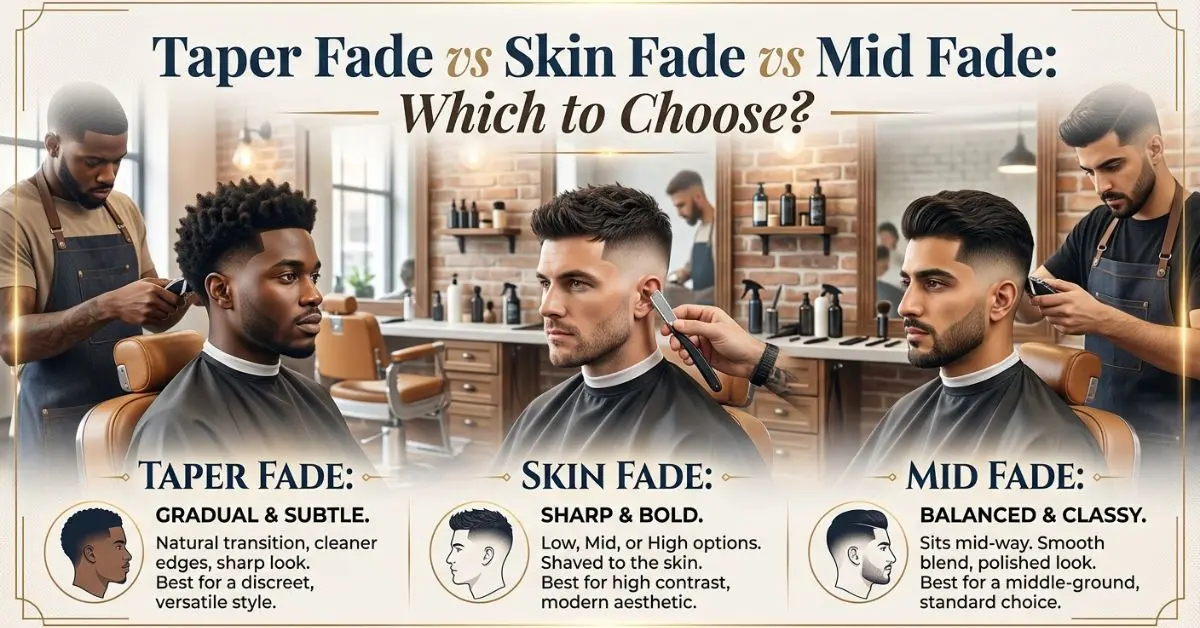
Taper Fade vs Skin Fade vs Mid Fade: Which to Choose?
You sit down, the barber asks what you want, and you say, “Uh, just a fade?” Most guys have done it. The catch is that a fade isn’t one haircut, it’s a whole category.
Taper fade vs skin fade vs mid fade is the question to answer before you sit down. Getting it right is the difference between the cut you pictured and one that’s close but not it.
This fade haircut guide explains the types of fades the way a barber thinks about them. It covers how to choose a fade, how to match it to your face and hair, and what to say to your barber when you’re in the chair.
It’s written for anyone who wants a fade haircut for men without the guesswork, whether you visit a traditional barber shop or a West Village barber.
What Is a Fade, Really?
A fade is a fade technique, not a single hairstyle. That’s the real answer to the hairstyle vs haircut confusion: a haircut is the technique and a hairstyle is the finished look. A fade is the gradient, the smooth transition where the hair goes from longer on top to shorter on the sides and back.
Every barbershop fade comes down to three fade dials:
- Where the fade starts. Low on the head, in the middle, or high near the temples.
- How short it goes at the bottom. A soft trim, a guard 1 buzz, or bare skin.
- How smooth the blend is. A short gradient with visible lines, or a long, invisible one.
Change one dial and you change the name. Once you know the dials, the fade jargon stops being confusing, and you can talk about fade variants like a pro.
The Three Main Types of Fades
Taper Fade
The taper fade is the most conservative of the three. The sides and back keep visible length, roughly a guard 2 to guard 3 on the clipper guard. The hair only gets noticeably shorter around the sideburns, the ear and the neckline. Think of it as a tidy haircut with a gradient around the edges.
It’s professional and office-friendly, it ages well, and it’s forgiving between cuts because there’s no sharp contrast to grow out quickly. A low taper is the softest version, often used on the neckline only.
Ask for a taper fade if: you want something clean that doesn’t read as a fade from across the room.
Skin Fade
A skin fade, also called a bald fade, is the boldest option. The bottom of the gradient goes all the way to bare skin with no guard at all, then blends up into longer hair on top. It’s a modern, high-contrast cut.
Done well, the hair looks like it’s dissolving into the scalp. Done badly, it looks like a bowl of hair sitting on a shaved head.
Ask for a skin fade if: you want a high-contrast look and you’re happy to visit every two to three weeks.
Mid Fade
The “mid” describes where the fade starts vertically. A mid fade begins roughly level with your temple, halfway between the ear and the top of the head. It has more presence than a low fade and is less dramatic than a high fade.
It’s the most requested of the three because it flatters the widest range of face shapes and hair types. If you’re genuinely unsure, start here.
Low, High and Burst Fades
A few cousins are worth knowing:
- Low fade: the gradient starts just above the ear. It’s subtle and reads as a sharp haircut rather than a fade.
- High fade: the gradient starts up near the crown. It’s very modern, very visible, and gives the biggest contrast on top.
- Burst fade: the gradient curves around the ear like a sunburst and leaves the back a little longer. It’s common with mohawk-ish styles.
- Drop fade: the fade line curves down behind the ear instead of running straight around the head.
The difference between a drop fade and a burst fade is the shape: a drop fade follows a downward arc behind the ear, while a burst fade circles the ear and leaves length at the back.
Taper Fade vs Low Fade, and Skin Fade vs Bald Fade
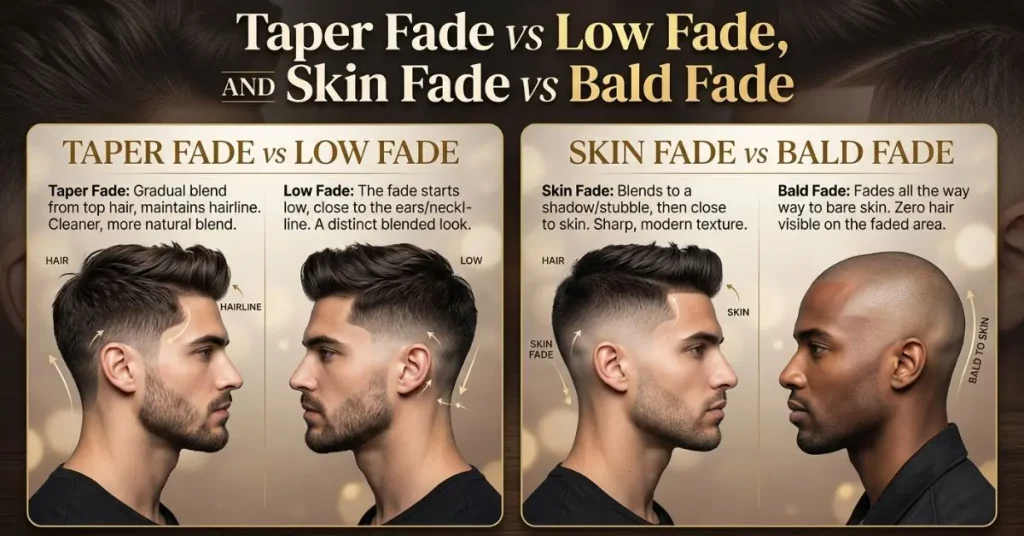
Two comparisons come up all the time.
Taper fade vs low fade: they’re close, but not identical. A taper keeps visible length and only shortens the sideburns and neckline. A low fade starts just above the ear and usually goes shorter at the bottom. A taper is softer and a low fade is a little more defined.
Skin fade vs bald fade: these are the same thing. “Bald fade” is just another name for a skin fade that reaches bare skin.
How to Choose a Fade: Face Shape
The best fade for face shape depends on proportions. A face shape haircut should balance what you already have.
- Round face: a mid or high fade adds vertical lines, so your face reads longer. Skip the low taper, which widens the jawline. For a round face, a mid fade is usually the best pick.
- Long or oval face: a low taper or low fade keeps things balanced. Avoid a high fade, which stretches the face further.
- Square face: almost any fade works. A mid fade is the safe bet.
- Heart-shaped face: a taper fade or low fade keeps attention away from a wide forehead.
How to Choose a Fade: Hair Density and Hair Texture
Hair density and hair texture change how a fade looks as much as face shape does.
- Thick or coarse hair: the best fade for thick hair is usually a skin fade. It gives the cleanest contrast and stops the bushy sides from building up.
- Fine or thinning hair: the best fade for thinning hair is a taper fade. The softer gradient hides the scalp show-through that a skin fade would expose.
- Curly or coily hair: all three work, but the best fade for curly hair is a mid or high fade, because it shows off the curl pattern on top.
- Ask for a textured scissor finish so the natural hair movement stays intact. A skin fade can work with curly hair too, since the contrast makes the curls stand out.
How Bold Do You Want It?
If someone described your new cut in one word, which would you want?
- Clean: taper fade
- Sharp: mid fade
- Fresh: skin fade
There’s no wrong answer. Just know which word you’re after.
Fade Maintenance: How Often to Get a Fade
Most guides skip fade maintenance, but it matters. The shorter the bottom, the faster the fade grow-out and the blurrier it gets.
- Taper fade: looks clean for four to five weeks. It’s the best low-maintenance fade.
- Mid fade: looks clean for three to four weeks.
- Skin fade: looks clean for two to three weeks.
So how often should you get a fade touched up? Plan a fade touch-up around those windows. If you can only visit once a month, don’t ask for a skin fade. You’ll love it for ten days, then watch it turn into a bad mid fade. Match the cut to your calendar.
What to Say to Your Barber
Barbers don’t need perfect barber vocabulary, they need specificity. This barber phrasebook gives you a simple barber template for how to ask for a fade:
“Can I get a [taper / low / mid / high / skin] fade, blending up to about [scissor length / 2 inches] on top, with a [scissor-cut / textured / hard part] finish?”
That’s three variables, and that’s what to ask your barber. Here are examples you can use as a custom fade request.
Taper fade: “Taper fade, please. Keep some length on the sides and back, and just clean up around the ears and neckline. Scissor-cut on top, about 2 inches on top.”
Skin fade: “Skin fade, mid. Start the fade around the temple and take it down to bare skin at the bottom. Leave about 2 inches on top with a textured finish.”
Mid fade: “Mid fade, blended up to about a guard 4, with scissor work on top. Keep some natural movement, not too blocky.”
Tell your barber which side you part your hair on, and mention any cowlick that refuses to behave. Show a photo to your barber if you have one.
Photos make everyone’s life easier. If you realise mid-cut that you want to go lower or softer, say so while you’re in the chair. A good barber would rather adjust than have you leave unhappy.
Booking Your Fade
Most shops let you book a fade online, and online booking usually takes under a minute. Pick the closest option on the service menu and add a note about the variant you want, or just explain it when you sit down. Some shops take walk-ins, so you can also drop by and wait. Check the payment policy before you go, because some places are cash only.
If it’s your first time in a barber shop, read up on what to expect on your first visit: how the chair works, how long it takes, and what the barber will ask.
Whether you’re searching for a West Village barber or any Manhattan barber shop, the same rules apply. Book your next appointment before you leave the chair, and your fade will always be on schedule.
Final Thoughts
The best fade is the one that fits your face shape, your hair and your calendar. Pick taper for clean, mid for sharp, or skin for fresh, then give your barber the three dials.
Specific words and a photo will get you the cut you pictured every time. Check back on the blog for more guides on styling, maintenance and what to ask for next.
FAQs:
What is a taper fade?
A taper fade is a haircut where the hair gradually becomes shorter around the sides and back, creating a clean and smooth transition.
Is a taper fade good for all hair types?
Yes, a taper fade can work well with straight, wavy, curly, and coily hair. The style can be adjusted to suit different textures.
How long does a taper fade last?
A taper fade usually looks sharp for about 2–4 weeks, depending on how quickly your hair grows and how clean you want the fade to look.
What is the difference between a taper and a fade?
A taper gradually shortens the hair around the sideburns and neckline, while a fade typically creates a more noticeable transition that can extend higher up the sides and back.
Can I style a taper fade with long hair on top?
Absolutely. A taper fade pairs well with longer hair on top, including textured crops, quiffs, curls, slick-backs, and messy styles.
