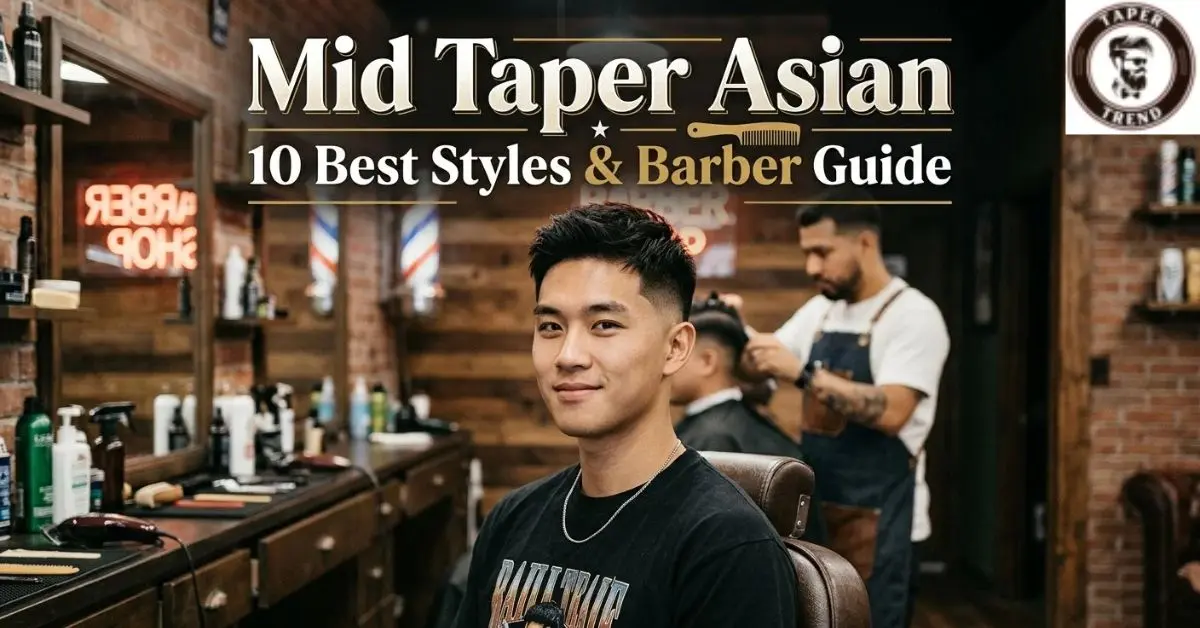
Mid Taper Asian: 10 Best Styles & Barber Guide
A mid taper Asian haircut shortens the sides gradually around the temple, sideburn and nape while the top keeps its weight. The mid taper Asian look works on straight, wavy, fine, dense and permed hair, but the version that suits you depends on your hair texture, density and growth direction, not your ethnicity.
This guide covers ten mid taper Asian styles, how to judge which one fits your hair, what to say to your barber, and how the cut behaves as it grows out. For the wider picture, read our guides on low taper fade haircuts, taper vs fade, and the mid taper fade.
The Quick Version of the Mid Taper Asian Cut
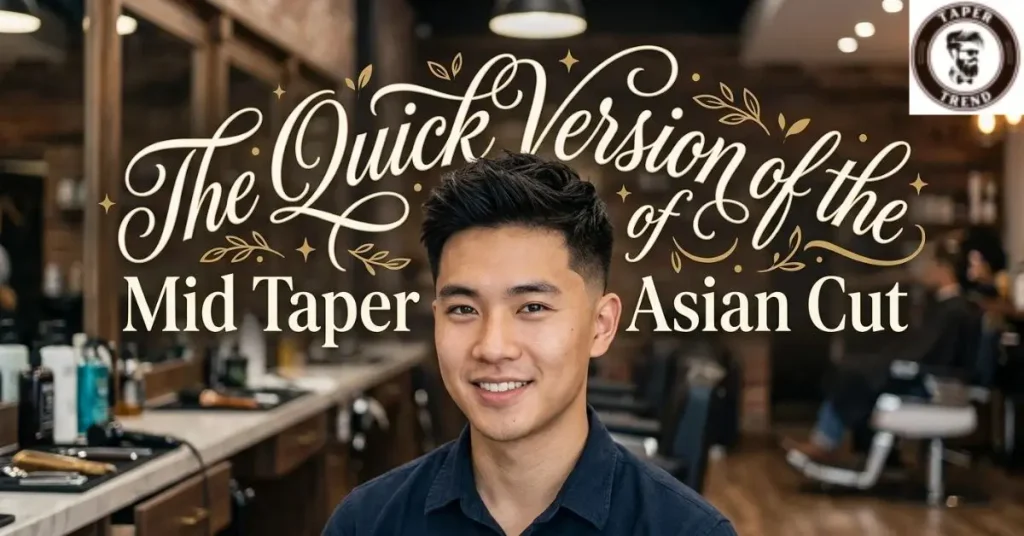
- The mid taper Asian taper concentrates around the temple, sideburn and nape at moderate height, so the sides look tidy without the hard line of a skin fade.
- Hair texture, density and growth direction decide the cut, not ethnicity. Bring a reference photo of hair that behaves like yours.
- Almost all the variation across the ten mid taper Asian styles comes from the top: length, texture and direction.
- Before the clippers start, settle one question: does the taper stop above the skin or go down to it? Shops read “taper fade” differently.
👉Read More: Mid Taper Black Male
What Is a Mid Taper Asian Haircut?
A mid taper Asian haircut is a clean, structured cut where the shortening is concentrated around the temple, sideburn and nape at roughly ear-to-temple height, blended gradually rather than cut to a hard line.
More bulk stays on the upper sides than a mid skin fade would leave. The top can be short, medium or long, so one base cut supports several finished looks.
The name is the weak point. Barbers use “taper” and “fade” almost interchangeably, but they describe different things. A classic taper closes down to the natural hairline without exposing skin above it.
A fade takes the hair to zero at the base and blends up from there. If you picture no skin and your barber pictures a zero at the base, you will get the wrong haircut. So settle the endpoint first: skin at the bottom, or not.
Where a Mid Taper Asian Cut Sits
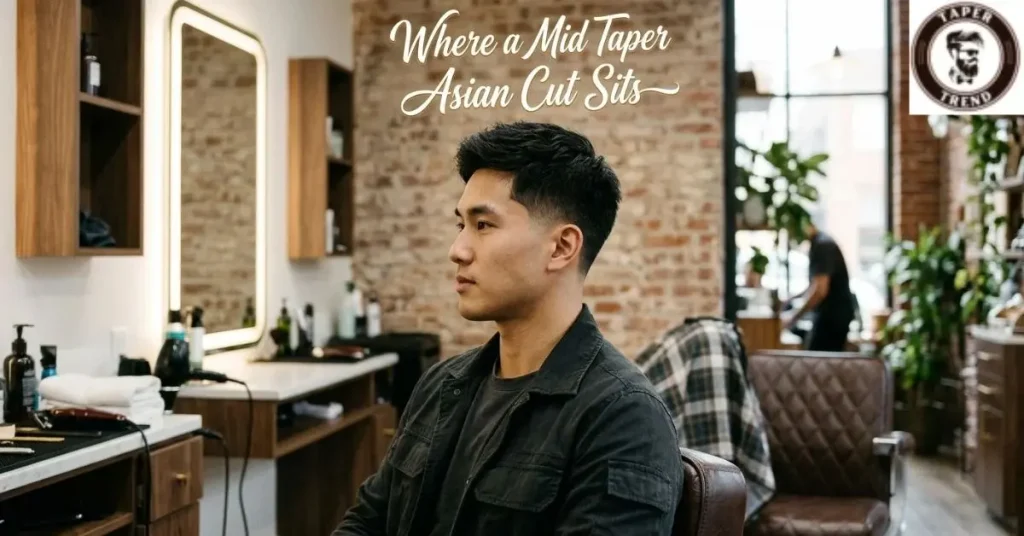
A mid taper sits between a low taper and a mid fade. The shortening starts higher than a low taper, which stays close to the natural hairline around the ears and nape, but it stops short of taking the whole side down the way a mid fade does.
The result is a perimeter that looks tidy rather than sharp. Contrast stays moderate, the sideburn and neckline look defined, and there is still enough hair on the upper sides to comb, part or push around.
If you are still deciding on height, compare a low taper vs a mid taper fade, or consider the low mid taper fade, which splits the difference.
👉Read More: Mid Taper Afro
Is Asian Hair a Hair Type?
Not in any sense that helps at the barber’s chair. Research on Asian hair reports population-level tendencies toward straight fibers, dark pigmentation, large strand diameter and a thicker, more compact cuticle layer.
The same research notes that cross-sectional area is shaped heavily by genetic variation, particularly the EDAR gene, and that the evidence is thin.
Averages are not people. Two clients with the same background can have different strand thickness, density and growth direction, and those variables decide how much weight a barber removes and where.
A reference photo of someone whose hair behaves like yours is worth more than one picked for matching ethnicity. The same logic applies to our guides on the low taper fade on Asian hair and the mid taper fade for white guys.
Who a Mid Taper Asian Cut Suits Best
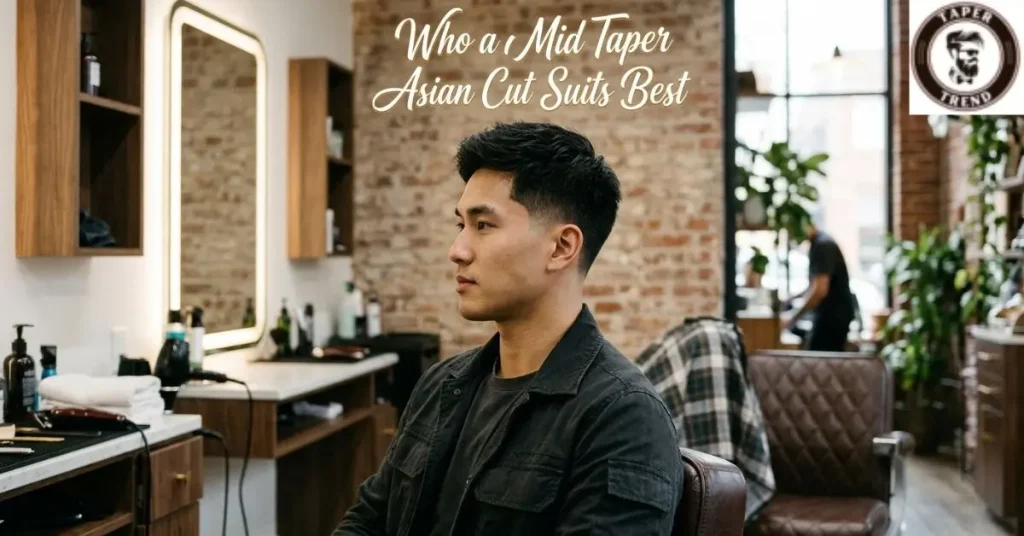
A mid taper Asian cut suits a wide range of people because it does not lock you into one silhouette. What decides whether it works is how your hair behaves day to day, plus head shape, hairline and how much contrast you want between top and sides.
👉Read More: Mid Taper Edgar
Hair Texture, Density and Growth Direction
These three decide how much side weight should stay and how the top sits once cut.
| Hair attribute | What to tell your barber |
|---|---|
| Straight, dense hair | Leave enough side weight to avoid a hollow look |
| Fine or low density hair | Thin lightly and conservatively |
| Wavy or permed hair | Preserve top movement instead of forcing a flat shape |
| Outward growth | Hair may still project; adjust length and weight, not just taper height |
| Strong crown or cowlick | Keep enough length so the hair sits naturally |
Straight, dense hair usually needs weight left on the sides. This is the same balancing act covered in our guides to the mid taper fade on straight hair and the drop fade for straight hair.
Fine hair does better with conservative thinning, since removing bulk from hair with little to spare shows quickly. Wavy or permed hair benefits from a cut that follows the wave rather than fighting it. A strong crown sets a floor on how short the back and top can go.
Face Shape, Head Shape, Hairline and Cowlicks
Face shape gives rough proportions to aim at: oval, round, square, heart-shaped, diamond and oblong.
Head shape, hairline and the direction your hair falls matter more once the cut is on your head, so face shape rules like “round faces need X” often fall apart in practice. A mid taper Asian cut generally adds structure to the jawline and cheekbones, and extra top height adds visual balance and symmetry on rounder faces.
Top height and fringe length are your adjustable tools. Mention a receding or asymmetrical hairline before the cut starts, since it changes how sharp or soft the front line-up should be. Warn your barber about a strong crown too, because hair cut too short there can refuse to lie flat or blend into the taper.
👉Read More: Mid Taper Modern Mullet
10 Mid Taper Asian Styles
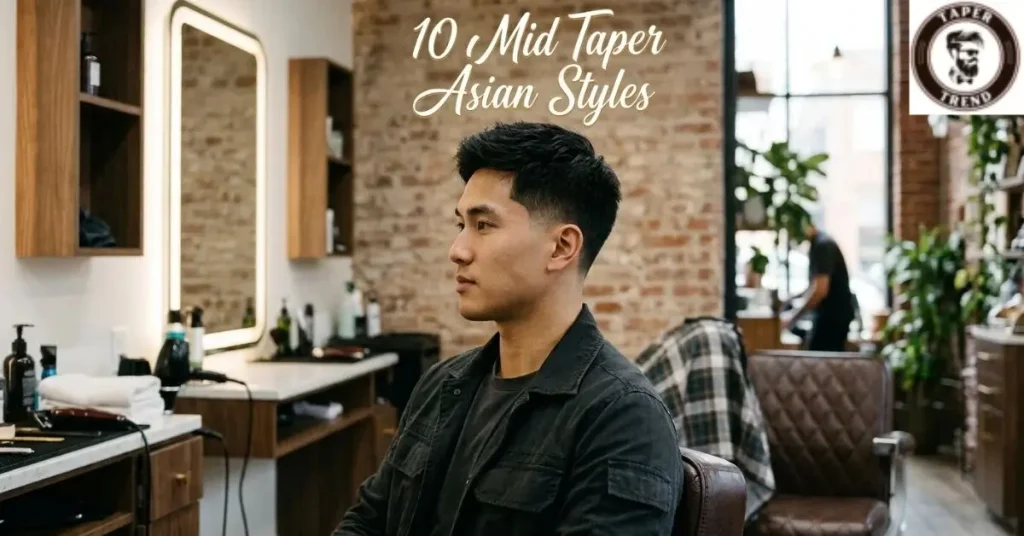
The taper stays the same across all ten mid taper Asian looks: a moderate, gradual shortening through the temple, sideburn and nape. The top changes. Treat these as starting points and adjust for your own texture, density and growth pattern.
Short and Textured Mid Taper Asian Styles
1. Classic mid taper Asian with a textured top
A close, even taper with a short, choppy top that gets its shape from texture, not length. It works on straight or slightly wavy hair of medium to high density. Work a small amount of clay or matte paste through damp or dry hair. Ask for even texturizing on top with no heavy layering underneath.
2. Mid taper Asian with a textured fringe
The top is left long enough to fall forward into a soft, broken fringe. It suits straight to wavy hair with enough density to hold shape.
Blow-dry forward with a light cream. Ask for enough weight at the front to fall rather than stand up. See also the mid taper fade with a textured fringe and the drop fade textured fringe.
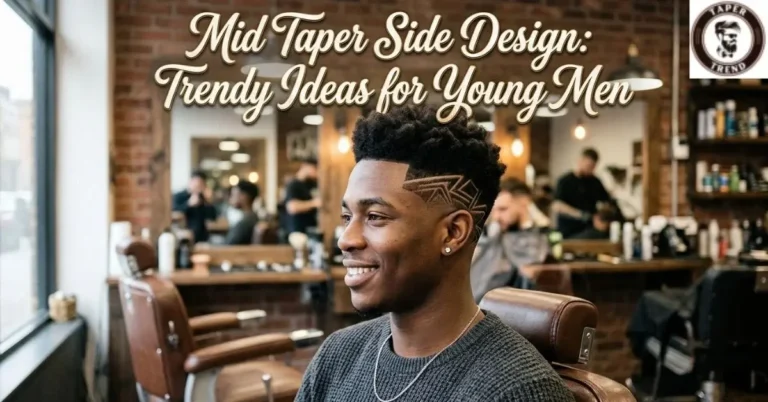
👉Read More: Mid Taper Side Design
3. Mid taper Asian with a textured crop
A longer, more structured crop with visible separation across the top. Medium to coarse straight hair carries it best, since finer hair can look thin once heavily texturized. Style with matte paste. Ask for texturizing on top rather than throughout, the same approach as a French crop.
Medium-Length and Korean-Inspired Mid Taper Asian Styles
4. Middle part or curtains with a mid taper Asian cut
Top hair is grown out and parted centrally so it falls forward on both sides, giving curtain-style flow.
It suits straight or lightly wavy hair, and needs a round brush or diffuser to train the direction. Ask how much length is being left for a center part, since it needs more than a fringe. Read more in our middle part styles and mid taper fade middle part guides.
5. Two-block with a mid taper Asian cut
Top and side lengths are treated as two zones with a visible step between them. Most textures carry it. Say you want a two-block structure as well as a taper, because many barbers treat these as separate requests.
👉Read More: Textured Mid Taper
6. Fluffy layered top with a mid taper Asian cut
Soft layers give volume and movement without a defined part or fringe. It suits fine to medium density hair that benefits from looking fuller. Style with light blow-drying and fingers. Ask for layering that adds shape without removing weight. See the mid taper fade on fluffy hair.
7. Mid taper Asian with a down perm
This pairs the taper with a chemical service that trains side and top hair to fall downward instead of sitting outward. It is an add-on, not part of the haircut, and it makes the most sense for hair with natural outward growth. Discuss your hair’s condition with a licensed stylist first. See our taper fade perm guide.
Longer, Wavy and More Defined Mid Taper Asian Styles
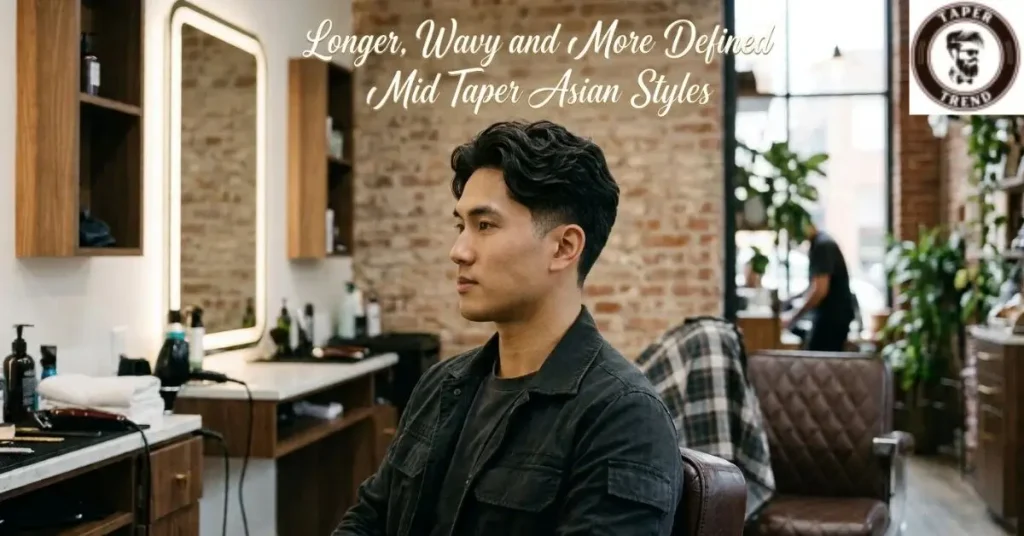
8. Wavy or permed top with a mid taper Asian cut
Natural or permed waves left long enough to move. Scrunch a light cream or sea salt spray into damp hair. Ask your barber to cut around the wave pattern, not against it. See the mid taper fade for wavy hair.
9. Blowout or quiff with a mid taper Asian cut
The top is dried upward and back for height at the front. Medium to thick hair holds lift best. You need a dryer, a round brush and a firmer product like paste or gel. Ask for extra length at the front hairline. See the mid taper fade blowout and quiff haircuts for men.
10. Slick back or side part with a mid taper Asian cut
Top hair is combed back or to one side for a smooth, polished finish. It works with most textures, though very fine hair may need heavier pomade or wax. Say “side part” if you want a defined line instead of a fully swept-back shape. See our slick back guide.
👉Read More: Mid Taper Fluffy Fringe
More Mid Taper Asian Variations
Beyond the ten core styles, the same temple-height taper works with a buzz cut, comb over, mullet, low cut, blonde hair, long hair, an Edgar cut with a blunt fringe, a custom hair design, or a beard fade for guys who want the taper blended into a full beard.
The mid taper Asian cut stays the foundation; only the top and finishing details change. It also suits teens who want a low-maintenance, streetwear-ready look for school and daily wear.
Mid Taper Asian vs Low Taper, Mid Fade, Two-Block and Undercut
These cuts differ in where the shortening is concentrated, how much contrast they create, whether skin shows, and how much side weight survives. None is better in the abstract.
| Cut | Where shortening concentrates | Contrast | Side weight kept | Best when |
|---|---|---|---|---|
| Low taper | Low, near the ear and nape | Subtle | Most | You want a quiet cleanup |
| Mid taper Asian | Temple, sideburn and nape | Moderate | Moderate to high | You want tidy sides without a hard fade line |
| Mid fade or skin fade | Broader zone, zero around ear level | Strong | Less | You want visible contrast or skin exposure |
| Two-block | Step between top and side length | Variable | Variable | You want a longer, disconnected top |
| Undercut | Hard separation between top and sides | Strong | Little to none | You want a deliberate, sharp disconnection |
Mid Taper vs Mid Fade
A mid taper blends gradually around the neckline and sideburns. A mid fade cuts higher and exposes more skin for bolder contrast. Compare the low vs mid vs high skin fade to see where each bare section stops, and the taper fade vs skin fade for the endpoint difference.
Mid Taper vs High Taper Fade
A high taper fade starts closer to the crown for stronger contrast and ultra-clean sides. The mid taper Asian cut offers a more balanced, tidy look.
Which Should You Choose?
Pick by contrast and by what your top style needs underneath. If your style leans on retained side weight, such as curtains, a fluffy top or a quiff, a mid or low taper blends more naturally than a skin fade.
If you want obvious contrast, choose a fade, two-block or undercut. When you cannot decide, bring a side-view photo, since taper height is the hardest part to describe.
How to Ask a Barber for a Mid Taper Asian Cut
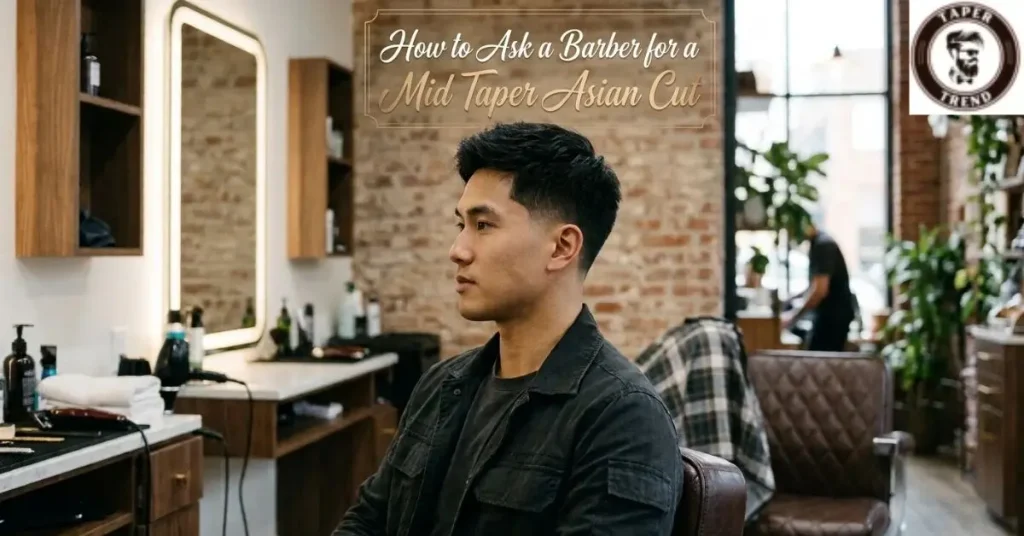
Bring a reference photo and cover five things: where the taper sits, whether it stops short of skin, how much weight stays on the upper sides, the top style and length, and anything unusual about your hairline or growth pattern. The name of the cut alone rarely gets you the picture in your head.
- Show the photo. Front, side and back, ideally of someone whose texture and density resemble yours.
- Point to the height. Say where the taper should sit and whether it stops above the skin or goes down to it.
- Set the side weight. State how much weight to leave on the upper sides, especially if a barber has taken too much off before.
- Describe the top. Fringe, crop, curtains, two-block, waves, quiff or slick back, and roughly how long.
- Flag the specifics. A strong cowlick, outward-growing sides, or a hairline you want left soft.
Put together, it sounds like this: “A mid taper through the temple, sideburn and nape, blended but stopping above the skin. Leave weight on the upper sides, and keep the top long enough for a center part.”
Guard numbers are weaker shorthand than they look. A blended side is built from a sequence of guard lengths and lever positions, and the clipper guard numbering does not mean the same thing in every shop. Describe the result and let the barber pick the tools.
What Should Your Reference Photo Show?
A useful photo shows taper height from the side, the neckline from the back, and the finished top clearly. One image covering all three is ideal, though separate photos work too. Choose someone whose hair behaves like yours, not someone chosen only for matching ethnicity.
How to Style a Mid Taper Asian Haircut
Daily styling follows the top, not the taper, because the sides need almost nothing between visits. Most of the routine goes into training the direction of the top and choosing how much hold and shine you want. Start by washing, towel-drying and detangling, then apply sea salt spray for grip.
| Finish | Technique | Product |
|---|---|---|
| Textured, matte | Work through damp or dry hair with fingers | Clay or matte paste |
| Forward-falling | Dry forward with a brush | Light cream or balm |
| Volume and height | Dry upward at the root | Firmer paste or gel |
| Sleek, controlled | Comb through while damp | Pomade or wax |
Match the product to the finish you want, not to texture or ethnicity. Finish with a light-hold hairspray or texture powder for all-day hold. If your style needs heat every morning, let hair partially air dry before styling and reduce how many days a week you use a dryer.
Best Products for a Mid Taper Asian Haircut
- Clay or texture clay: strong hold and a matte finish.
- Matte paste or molding paste: flexible hold and easy restyling.
- Texture powder: instant root lift for flat hair.
- Pomade, wax or gel: shine and structure for side parts and slick backs.
- Sea salt spray: a pre-styler for grip and light texture.
- Styling cream, light cream or balm: smooth texture and frizz control.
- Curl cream: defines waves and curls.
- Volumizing mousse: builds lift before blow-drying.
- Hydrating argan oil: softens dry hair and smooths the ends.
- Clarifying shampoo: removes buildup, grease and old product.
- Hydrating conditioner: restores softness and makes hair easier to style.
How to Maintain a Mid Taper Asian Cut
How Often Does a Mid Taper Need a Touch-Up?
No single interval fits everyone. It depends on how fast your hair grows, how high and tight the taper is, and how much regrowth you tolerate. A taper that stops above the skin usually holds longer than a skin fade, since a fade shows growth quickly where bare skin meets the first guard length.
As a rough range, fade clients return every two to three weeks and taper clients every three to four weeks. Watch for the temple and neckline losing their edge, or the top overwhelming the proportions of the cut.
Heat, Close Shaving and Scalp Irritation
Excessive heat damages hair of any texture. Use flat irons only on dry hair at a low or medium setting, and no more than every other day, to avoid heat damage.
Very close clipper or razor work carries a different risk: shaving is a common cause of folliculitis, the acne-like razor bumps that appear when hair follicles are damaged and infected. If bumps keep returning along your neckline, ask your barber for slightly more length there and see a dermatologist if they persist.
Final Thoughts
A mid taper Asian haircut is not one haircut. It is a moderate, temple-height blend that leaves enough weight on the upper sides to carry a crop, fringe, curtains, two-block or slick back, and it looks tidy without the hard line of a skin fade.
Pick your version by texture, density and growth direction, agree the top length before the first pass, and say out loud whether the taper stops above the skin. Get those three right and the cut grows out on your terms.
FAQs:
What is a mid taper Asian haircut?
A mid taper Asian haircut is a clean, structured cut where the hair is shortened gradually around the temple, sideburn and nape at a moderate height. The sides look tidy, while the top keeps its weight. It works on straight, wavy, fine, dense and permed hair.
Is a mid taper Asian cut good for thick, straight hair?
Yes. A mid taper Asian cut suits thick, straight hair well, as long as enough weight stays on the upper sides to avoid a hollow look. The taper removes bulk around the perimeter, so the top looks neat and controlled, whether you choose a textured crop, a fringe or a slick back.
How do I ask my barber for a mid taper Asian haircut?
Bring a side-view reference photo of someone whose hair behaves like yours. Tell your barber where the taper should sit, whether it stops above the skin or goes down to it, how much weight to leave on the upper sides, and how long you want the top. Describe the result instead of using guard numbers.
Which hairstyles go best with a mid taper Asian cut?
A mid taper Asian cut pairs well with a textured top, textured fringe, textured crop, middle part or curtains, two-block, fluffy layers, down perm, waves, quiff and slick back. The taper stays the same, and only the top length, texture and direction change.
How often does a mid taper Asian haircut need a touch-up?
It depends on how fast your hair grows and how tight the taper is. As a rough range, a taper holds for about three to four weeks, while a skin fade needs a touch-up every two to three weeks. Book a trim when the temple and neckline start losing their edge.




One Comment