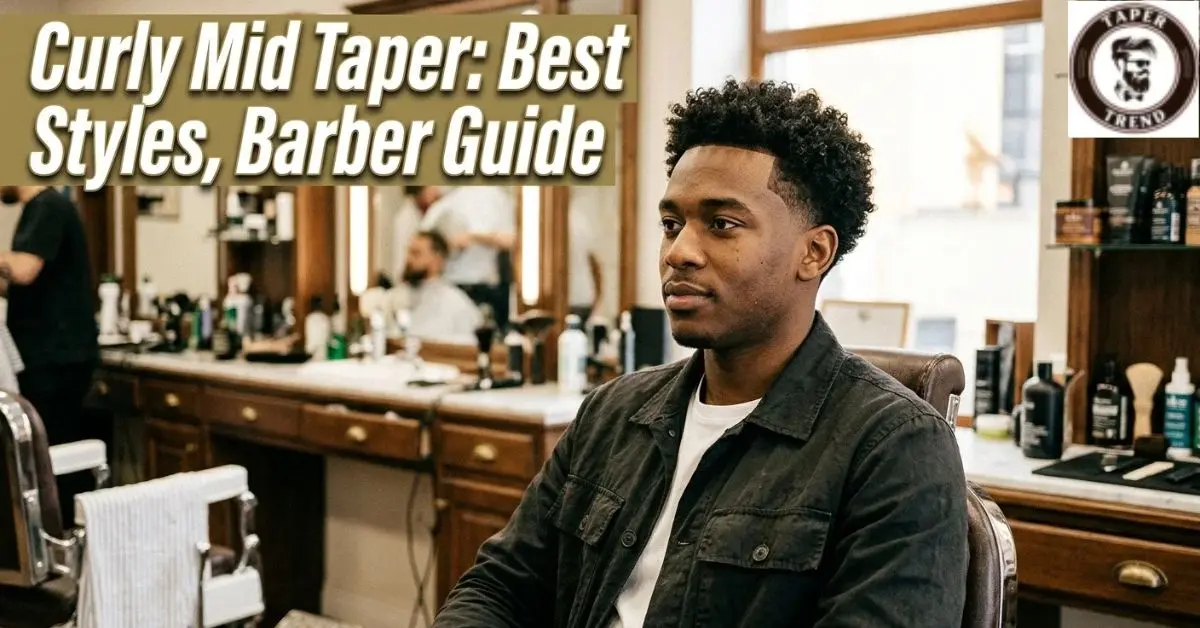
Curly Mid Taper: Best Styles, Barber Guide
A curly mid taper keeps your curls at their natural length on top while the sides and back shorten gradually, with the blend starting around the temple.
Barbers place that blend differently from shop to shop, so the result depends far less on the name than on four things you specify in the chair: where the taper starts, how short it finishes, how much curl stays on top, and where the bulk sits.
This guide covers mid taper fade curly hair styles, the exact wording to use with your barber, and how to keep both the taper and the curls looking their best. It is written for anyone who wants a curly mid taper and for anyone asking how to ask for a mid taper curly hair cut.
The Quick Version
- A taper concentrates the shortest hair around the sideburns, temples, and neckline, while a fade shortens a wider band of the side.
- “Mid” is a height, not a finish. The taper can stop at a guard length or a shadow instead of skin.
- Curl pattern does not decide whether a curly mid taper works. It changes how the silhouette reads once the sides are shortened.
- Shrinkage is what barbers most often misjudge, so agree on dry length rather than wet length.
- Touch-ups land between two and four weeks, driven by how close the finish is.
Read More: Mid Taper Asian
What Is a Mid Taper Fade on Curly Hair?
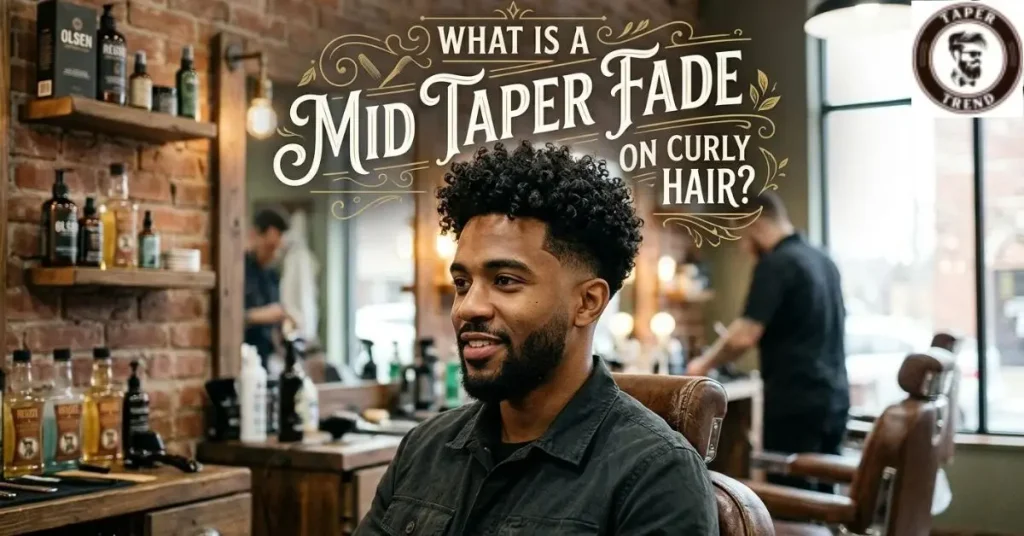
A mid taper fade on curly hair keeps the curls at their natural length across the top and crown while the sides and back shorten gradually. It keeps more side weight than a mid fade and shows more contrast than a low taper.
On curly hair, this division does a specific job. Curls carry their volume outward and upward, so shortening the perimeter draws a clean outline without touching the curly crown that gives the style its shape. The sideburns, hairline, nape, and neckline stay tidy while the curls keep their natural length.
Mid Taper vs. Mid Fade
A taper and a fade are not the same instruction, though many shops use the words interchangeably. A taper changes length more gradually and leaves hair longer on the sides. A mid fade takes a broader section of the side and back down short, sometimes to skin. Since the vocabulary won’t settle it, bring a reference photo and name the finish: shadow, skin, or blended.
👉Read More: Mid Taper Black Male
Mid Taper vs. Low Taper vs. High Taper Curly
| Taper height | Blend starts | Side weight | Contrast |
|---|---|---|---|
| Low taper | Near the ear and nape | Most | Subtle |
| Mid taper | Around the temple | Moderate | Moderate |
| High taper | Above the temple | Least | Strong |
A low taper keeps nearly all the side volume and suits a conservative dress code or fine sides. A high taper exposes more scalp and sharpens the break against curly volume, but needs more upkeep. A curly mid taper sits between the two and stays adjustable. If you are torn, remember that a barber can go higher next visit, but nobody can put length back on the same day.
Is a Mid Taper Good for Curly Hair?
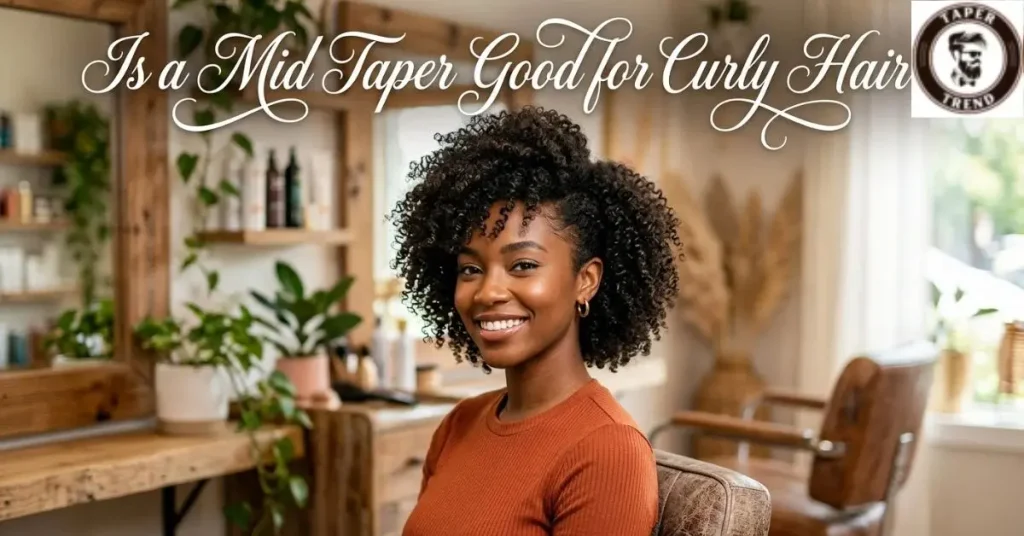
For most people, yes, because the cut shapes the perimeter rather than changing how the curls behave. Three things matter more than any curl classification: a barber with textured-hair experience, a reference photo close to your own density, and an honest answer about styling time.
The taper works on loose curls, tight curls, coily hair, afro-textured hair, and even wavy hair. Denser, tighter patterns build a fuller crown that reads strongly against shortened sides, while looser curls blend into the taper line with less visible step. The variables that matter are density, curl diameter, and shrinkage.
Top length changes what the taper does. Short curls give a compact silhouette, medium length balances definition and easy styling, and a mid taper fade curly hair long on top adds movement but needs more product and careful drying. Decide top length and taper height before the appointment, because they are separate instructions.
👉Read More: Mid Taper Afro
Best Curly Mid Taper Styles
- Classic curly mid taper: Curls at a natural, moderate length over a cleanly shortened perimeter. It looks neat, needs little product, and is a sensible default for a first taper.
- Mid taper with curly fringe: The top curls are cut and directed forward so a fringe covers part of the forehead. Name the fringe length and forehead coverage specifically.
- Curly mid taper blowout: More height on top, dried and lifted outward over a clean tapered perimeter. It takes the most effort day to day, because the volume comes from how you dry it.
- Short curly mid taper: Top curls cut close and even, with the taper lines as the dominant feature. It needs the least styling time, but gives less room to change between appointments.
- Mid taper with coily or afro-textured hair: The taper sculpts the crown’s natural shape rather than compressing it. This is a popular choice for a mid taper fade curly hair black men look, from an afro to twists.
- Mid taper with line-up or beard blend: A line-up sharpens the hairline and temple edges. A beard blend runs the sideburn taper into facial hair, which makes a curly mid taper with beard look finished. Both add upkeep, since edges look untidy first.
👉Read More: Mid Taper Edgar
What to Ask Your Barber For
A workable brief covers five things. This is how to ask for a mid taper curly hair cut:
- Show a reference photo. Bring clear photos from the front and side, ideally with density and curl pattern close to your own.
- Say where the taper begins. Point at the spot. Around the temple is the usual mid reference.
- Decide how short the bottom goes. Skin, guard length, or soft shadow. A taper does not have to go to skin.
- Explain how much curl length to keep. Describe the result you want, and ask your barber to check dry length before the cut is finished.
- Discuss bulk, fringe, and neckline. Say where fullness should stay and whether the neckline follows its natural shape or gets squared off.
Try this wording: “I’d like a curly mid taper. Start the blend around the temple, finish at a soft shadow rather than skin, and leave enough length on top to keep my curl definition. Check it dry before we call it done.”
Our free barber brief generator and clipper guard size chart turn these choices into a card you can show on your phone. If you are unsure about height, the face shape detector can help.
👉Read More: Mid Taper Modern Mullet
How to Style a Mid Taper with Curly Hair
Work on damp hair, add a leave-in and a definition product, then dry without disturbing the curl pattern. Only the top needs styling.
- Start with damp, detangled hair. Detangle while wet, using fingers or a wide-tooth comb in sections. The American Academy of Dermatology (AAD) advises against brushing curly hair dry, which causes breakage and frizz.
- Add moisture and definition. Apply a leave-in conditioner first, then a curl cream, mousse, or gel depending on the hold you want. Use the smallest amount that works and keep it off the scalp.
- Air-dry or diffuse. Air-drying is gentler. If you diffuse, use low heat and scrunch upward rather than pulling down, which flattens the curls against the taper line.
- Refresh between wash days. Mist with water and work in a little leave-in. Wash when needed rather than on a fixed schedule, since over-washing leaves curls dry and frizzy. CurlyCheck’s wavy hair wash day routine is a helpful reference for looser patterns.
How to Maintain a Curly Mid Taper
Two schedules run in parallel. The taper needs a barber every few weeks, while the curls need moisture and gentle handling continuously. For mid taper curly hair maintenance:
- Touch-up timing: Every two to four weeks, depending on the finish. A shadow finish lasts longer, while skin needs the shorter end of the range. The clearest signal is when the blend stops looking like a blend and starts looking like growth.
- Between visits: Clean up only the neckline and sideburns yourself and leave the blend alone.
- Curl care: Condition all of the curls, not just the ends, and follow with a leave-in or oil after washing.
- Overnight: A loose pineapple ponytail, a satin or silk pillowcase, or a durag reduces friction and protects the shorter sides.
Common Mistakes to Avoid
- Taking the taper higher than intended: If the line lands above the temple, a mid taper quietly becomes a high taper. Point to the starting point before the first pass.
- Removing too much bulk from the top: Curly hair shrinks as it dries, so a top cut wet can look shorter once it springs back. Ask for dry length to be checked.
- Using a reference photo from a different texture: A photo of straight hair will not translate onto tighter curls. Bring examples close to your own pattern and density.
Alternatives to a Curly Mid Taper
- Subtler: A low taper, which keeps the most side weight. A curly low taper or low taper fade afro is a good place to start.
- More contrast: A high taper, a mid fade, or a skin fade curly hair cut.
- Curved around the ear: A burst fade curly hair cut.
- Curving down at the back: A drop fade curly hair cut.
- Temples only: A temple fade, also called a temp fade.
Final Thoughts
A curly mid taper works because it reshapes the perimeter and leaves the curl pattern alone, which is why it adapts across every hair type. The name is the least reliable part of it.
Bring a side and back reference photo, point to where the blend should start, name the finish as skin or shadow, say how much curl length stays, and agree on the neckline before anyone picks up the clippers. Then keep the routine simple: damp hair, a leave-in, low heat or none, and a touch-up when the blend starts reading as growth.
FAQs:
What is a curly mid taper?
A curly mid taper keeps your curls at their natural length on top while the sides and back shorten gradually, with the blend starting around the temple. It keeps more side weight than a mid fade and shows more contrast than a low taper.
Is a curly mid taper good for all curl types?
Yes, for most people. It works on loose curls, tight curls, coily hair, and afro-textured hair because the cut shapes the perimeter and leaves the curl pattern alone. Denser, tighter curls build a fuller crown, while looser curls blend into the taper line more softly.
How do you ask your barber for a curly mid taper?
Bring a front and side reference photo, point to where the blend should start (around the temple), and say whether the finish is skin, guard length, or soft shadow. Then explain how much curl length to keep, and ask the barber to check dry length before finishing, since curls shrink as they dry.
How often does a curly mid taper need a touch-up?
Every two to four weeks. A shadow finish lasts longer, while a skin finish needs the shorter end of that range. The best signal is when the blend stops looking like a blend and starts looking like growth.
How do you style and maintain a curly mid taper?
Work on damp, detangled hair, apply a leave-in conditioner and a curl cream, mousse, or gel, then air-dry or diffuse on low heat. Only the top needs styling. Condition the curls regularly, and use a satin pillowcase or a loose pineapple ponytail at night to reduce friction.