

Mid Taper Buzz Cut: Guard Lengths, Styles & Barber Guide
A mid taper buzz cut is a short, even clipper cut on top with sides that gradually get shorter, starting around the middle of the ear and finishing at the neckline.
It sits between a gentle low taper and a bold high taper, which is why it is one of the most requested short men’s haircuts in any barbershop. It looks neat, needs almost no daily styling, and still has more shape than a plain one-length buzz cut.
There is one catch. Barbers do not all use the word “mid” in the same way, so the label alone will not guarantee the result you want.
This guide covers guard lengths, the best variations, who the cut suits, the exact words to use in the chair, upkeep, risks, and the closest alternatives. If you want the wider family first, read our complete mid taper fade guide. For the softer, lower version, see our low taper fade haircuts guide.
The Quick Version
- “Mid” tells you where the taper starts (level with the middle of the ear), not how long the top is. Treat top length and taper placement as two separate decisions.
- The top is usually a #1, #2 or #3 guard, about 3mm to 9.5mm. A #2 is the dependable, classic starting point.
- The taper does not have to reach bare skin. It can finish at skin, at a light shadow, or at a slightly longer length.
- Tell your barber five things: top length, taper placement, bottom finish, hairline style and a reference photo.
- Plan a refresh every two to three weeks, and protect your scalp from the sun.
What Is a Mid Taper Buzz Cut?
A mid taper buzz cut (also written as a mid taper fade buzz cut) keeps the top uniformly short, usually with a single clipper guard. The sides and back then graduate from short to shorter, beginning roughly level with the middle of the ear.
That graduation is what separates a tapered buzz cut from a plain buzz cut with no shaping.
The terminology is not standardized. Some barbers use “mid taper” and “mid fade” as the same thing. Others say “fade” when the hair ends at bare skin and “taper” when a light shadow is left at the bottom.
Neither habit is wrong. That is why a photo, or a clear description of the finish you want, works better than the name alone.
Where Does the “Mid” Sit?
The “mid” in mid taper describes where the graduation begins. A low taper starts near the earlobe and nape, a high taper starts closer to the temple, and a mid taper begins in between.
Your barber will shift that point based on your hairline, ear position and how much contrast you want. Pointing to the spot on your own head beats quoting a measurement. For a full comparison, see our low taper fade vs mid taper fade guide.
What Makes It a Buzz Cut?
The buzz cut part means the top is clipped short and even, too short to comb or style with product. According to Wahl’s guard guide, a #1 is a short buzz, a #2 is a traditional buzz cut, and a #3 is a longer buzz. Around a #4 you move into crew cut or brush cut territory.
Mid Taper Buzz Cut vs Similar Cuts
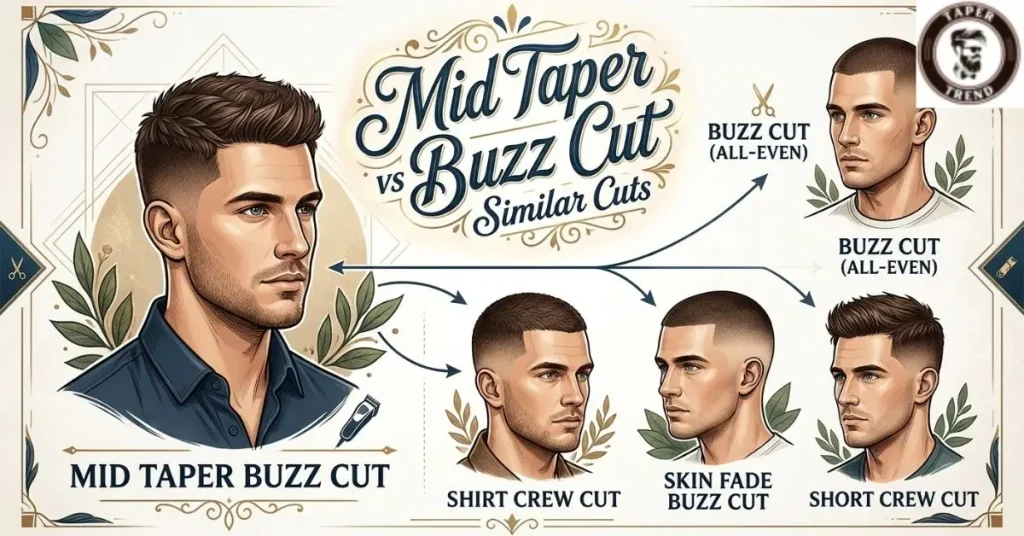
The difference between a mid taper, mid fade, low taper and high taper comes down to where the graduation starts, how much hair comes off the sides, and how much contrast shows against the top. These are points on a sliding scale, not fixed recipes.
| Cut | Where graduation starts | Hair kept | Contrast |
|---|---|---|---|
| Low taper buzz cut | Near the earlobe and nape | Most | Subtle |
| Mid taper buzz cut | Level with the middle of the ear | Moderate | Balanced |
| High taper buzz cut | Closer to the temple | Least | Strong |
| Mid fade buzz cut | Similar height, often taken to skin | Moderate, shorter at the base | Strongest at the base |
| Classic buzz cut | No graduation | Uniform | None |
Mid Taper vs Mid Fade
Both usually start at about the same height. The difference is the bottom: a taper tends to leave a little length or a soft shadow fade, while a fade is more likely to go all the way down to skin (often called a skin fade or bald fade).
Because many barbers use the words interchangeably, describe the bottom finish you want. Our taper vs fade breakdown explains the difference at every height.
Low vs Mid vs High Taper Buzz Cut
A low taper buzz cut keeps more bulk on the sides and looks subtle. A high taper buzz cut starts near the temple and creates sharper contrast against the buzzed top. You can see that climb in our high taper fade guide.
The mid taper sits in the middle: enough graduation to look deliberate, without the sharp visual step of a high fade. Higher, sharper tapers also show regrowth sooner, so they need more barber visits.
Tapered Buzz Cut vs Classic Buzz Cut or Crew Cut
A classic buzz cut uses one guard length everywhere, with no shaping. A buzz cut with a taper adds shape around the temples, ears and neckline while keeping the same short top.
A crew cut has a similar taper but keeps enough length on top for a comb, so styling becomes a factor again. A French crop with a taper fade is closer to that styled end of the range. The traditional short back and sides is the older cousin of all of these.
Will a Mid Taper Buzz Cut Suit You?
No haircut works the same on every head. Whether this one suits you depends on your hair texture and density, your head and face proportions, and how much contrast you want to live with.
How Hair Texture and Density Change the Look
- Straight, fine hair: Lies flat and shows the taper line clearly, so a slightly softer graduation often looks better than a hard one.
- Curly or coily hair: Natural volume blurs the line, and curl shrinkage makes the cut look shorter. The taper may need to start a little higher to stay visible.
- Dense hair: Holds its shape at a short guard, so a #1 or #2 still looks solid.
- Thinning hair: Shows more scalp at the same setting. Going one guard longer on top is usually the easier fix.
We cover this in more detail in our mid taper fade for Black men guide and our guide to straight, fine hair.
How Face and Head Proportions Affect the Result
Instead of matching the cut to a face shape, think in terms of proportion. Starting the taper higher narrows the lower head and jaw area. Starting it lower keeps the sides fuller. Where your barber places that transition is the main lever. If you are unsure, try our Face Shape Detector before your visit.
Receding Hairline, Thinning Hair and Cowlicks
Very short hair reduces the length contrast that makes a thinning crown or receding hairline stand out, which is why many men dealing with hair loss choose a buzz cut.
It is a trade-off, not a fix: shorter hair also makes the hairline itself easier to see, and no haircut hides recession. Our haircuts for a receding hairline guide explains this in full. A cowlick usually settles at very short lengths because there is not enough hair left to lift.
Which Clipper Guard Should You Choose?
The top of a mid taper buzz cut is normally cut with a #1, #2 or #3 guard, roughly 1/8 inch to 3/8 inch (about 3mm to 9.5mm).
The guard number only describes the top. It says nothing about the taper, so decide top length and taper placement separately. Our clipper guard size chart and haircut numbers chart convert every guard to inches and millimeters.
| Guard | Length | Look |
|---|---|---|
| #1 | 1/8 in (3.2mm) | Very short, scalp clearly visible |
| #2 | 1/4 in (6.4mm) | Classic buzz, balanced coverage |
| #3 | 3/8 in (9.5mm) | Longer buzz, more texture shows |
Sizes from Wahl USA. Guard numbering is consistent across most consumer clipper brands, but confirm with your barber if the exact length matters.
#1, #2 and #3 on Top
- #1 for sharp contrast: The most scalp shows through, and the step into the taper is at its most visible. It is the boldest and lowest-effort option.
- #2 for a classic short buzz: The safest starting point if you are unsure. It keeps enough hair to read as a haircut rather than a shave.
- #3 for a softer, longer buzz: Enough length for wave or curl to show, while still needing almost no styling.
Longer Than a #4: The Brush Cut Crossover
Past roughly a #4 guard the style behaves like a brush cut or crew cut. It holds a slight shape, can be lightly combed, and usually wants a little product.
Should the Taper End at Skin, Zero or a Shadow?
The taper can end at bare skin, at a close shadow left by an open blade, or at a slightly longer length. Each choice changes your upkeep and skin exposure. Wahl’s chart bottoms out at a #1/2 guard (1/16 inch), the shortest length before bald.
Anything closer than that is bare-blade work, and true bare skin usually means a foil shaver or razor. Many clippers have a taper lever that adjusts closeness between guard lengths.
Barbers use it to blend each section smoothly, and our best clippers for fades roundup compares lever designs.
Best Mid Taper Buzz Cut Variations
There are fewer true variations than a gallery suggests. Most of the visible difference comes from two choices: how long the top is, and how the edges are finished.
By Top Length
- #1 mid taper buzz: The sharpest, most scalp-visible version.
- #2 mid taper buzz: The common baseline. Balanced and low-styling.
- #3 mid taper buzz: Softer, with room for texture.
- Longer buzz with a mid taper: A #4 or longer on top. The shape survives, but you are now maintaining a crew cut.
By Edge Finish
- Natural hairline: Left where it grows, for a softer edge that grows out without an obvious line.
- Sharp line-up: A crisp edge along the hairline, temples and neckline, cut with a trimmer or razor. It looks best in the first week and needs the most touch-ups.
- Skin-close mid taper: The taper goes all the way to bare skin, giving maximum contrast and exposing the most skin at the nape.
- Mid taper blended into a beard: The temple taper and ear taper flow into the sideburns and beard line so the haircut and facial hair look like one shape.
For more short-top shapes over a mid blend, see our mid taper fade for short hair guide.
For the beard version, read our mid taper fade with beard guide, drop fade with beard guide and skin fade with beard guide. If you like the curved version, our mid drop fade and drop fade for straight hair guides show it under a buzzed top.
How to Ask Your Barber for a Mid Taper Buzz Cut
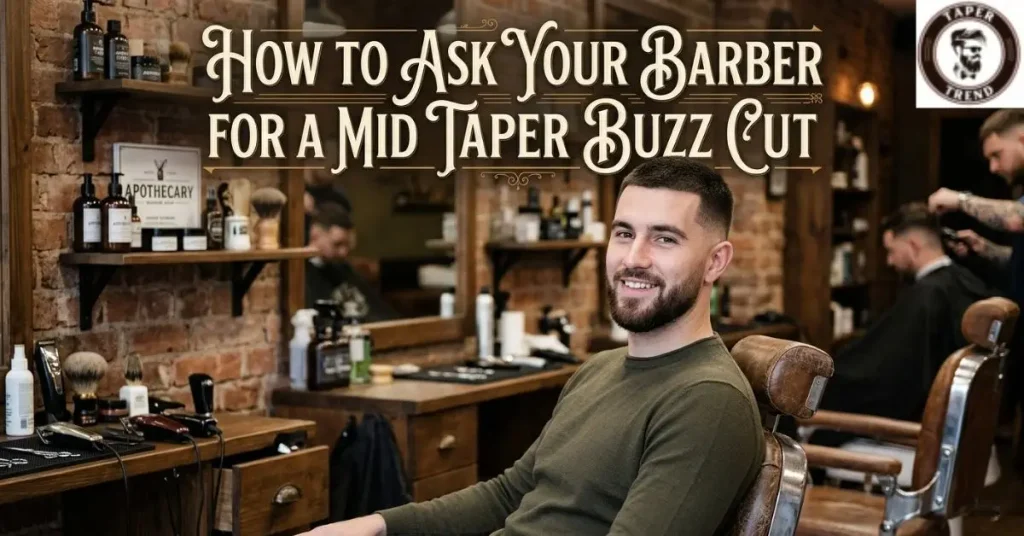
Naming the style alone leaves too much open. Before the clippers start, specify these five things:
- Top guard or length. Give a guard number, or a length in inches or millimeters.
- Taper placement. Point to where on the side of your head the graduation should begin.
- Bottom finish. Say whether it ends at skin, at a close shadow, or with a little length left.
- Hairline and neckline. Choose a sharp line-up or a soft natural edge.
- Reference photo. Bring one that shows the side and back, and confirm the neckline.
Ready-to-Use Barber Scripts
Balanced #2 version: “A #2 on top, taper starting around the middle of my ear, blending down to a short shadow rather than full skin, with a natural hairline.”
Softer, non-skin version: “A #3 on top, taper starting a little lower near my earlobe, finishing with some length left at the bottom instead of going to skin.”
Sharper skin-close version: “A #2 on top, taper starting higher near my temple, going all the way down to skin, with a clean line-up.”
Add one line to any of them: “Adjust it if you think something else suits my hair better.” You can also build a ready card with our Barber Brief Generator.
How to Maintain a Mid Taper Buzz Cut
This cut needs almost no daily styling, but it does need regular barber visits. The taper grows out faster, visually, than the top, because a few millimeters at the base changes the shape far more than the same growth on a #2 top.
How Often Should You Refresh It?
Scalp hair grows about 0.35mm a day, roughly half an inch a month, or about 2.5mm a week. A skin-close bottom is back to about #1 length in around nine days, and close to a #2 in about two and a half weeks.
For most people, a refresh every two to three weeks works. Go sooner for skin finishes and sharp line-ups, and later for soft natural tapers.
Watch the silhouette rather than the calendar: when the line between the top and the taper starts to blur, book in. Our how often should you get a haircut guide covers buzz cut timing, and our Barber Tip Calculator helps with the bill.
Between Barber Visits
- Wash your scalp regularly. A short cut leaves more skin exposed and less hair to absorb oil.
- Tidy stray neckline hairs with a trimmer, staying below the line your barber cut.
- Do not try to fix the taper yourself. A shaky correction creates more work later, and pushing the neckline back over several attempts is the most common self-inflicted damage.
- If you cut at home, a clipper kit with a full guard set, a trimmer for edges, a 3-way mirror and a few drops of blade oil make it easier. Brands such as Wahl, Andis and Panasonic (for a foil shaver finish) are common choices. Our beginner fade-cutting guide explains the technique.
Risks and Limitations of a Very Short Tapered Buzz
A close cut trades coverage for low styling effort and more exposed skin. Think about neck skin sensitivity, sun exposure and how often you are willing to visit the barber.
Close Shaving, Razor Bumps and AKN
The American Academy of Dermatology (AAD) lists frequent close-shave haircuts among the things that can irritate the back of the neck and scalp in acne keloidalis nuchae (AKN).
In AKN, inflamed follicles form bumps and, without treatment, can lead to scarring and permanent hair loss in the area. The risk is greatest in men of African ancestry, and it also occurs in Hispanic and Asian men with darker skin and coarse, curly hair. Razor bumps are a milder, related irritation.
If you already have AKN, the AAD advises avoiding haircuts that shave the back of the neck and head. In practice, that points to a taper that stops at a guard length rather than a skin-close nape. If you get persistent bumps, see a board-certified dermatologist.
Scalp Exposure and Sun Protection
A very short buzz exposes more scalp to UV exposure. The AAD recommends a broad-spectrum, water-resistant sunscreen with SPF 30 or higher on all skin not covered by clothing.
For thinning hair, it suggests applying sunscreen to the scalp or wearing a wide-brimmed hat. The same sensible habit applies to a freshly buzzed head.
What to Get Instead of a Mid Taper Buzz Cut
If the contrast, upkeep or skin exposure gives you pause, these cuts solve for different priorities.
| Alternative | Choose it for | Trade-off |
|---|---|---|
| Low taper buzz cut | Softer contrast, more forgiving grow-out | Less defined shape |
| One-length buzz cut | Simplest to maintain, easy to do yourself | No shaping at the edges |
| Mid fade buzz cut | Maximum contrast at the base | Shows regrowth fastest |
| Crew cut | Some styling flexibility on top | Needs product and combing |
| Textured crop | More coverage and movement | Highest daily effort of the five |
A low taper keeps more bulk on the sides and grows out kindly. Our low taper fade buzz cut guide covers it.
A one-length buzz is the easiest to get right with a single guard. A mid fade takes the blend to bare skin for sharper contrast, while a crew cut or textured crop keeps a #4 or longer on top for styling flexibility.
Making the Final Call
A mid taper buzz cut works best when you treat “mid taper” as the start of a conversation, not a fixed order. Pick a top guard, decide how far the taper should graduate, choose a hairline style, and most of the guesswork disappears.
After that, the routine is simple: a barber visit every couple of weeks, sunscreen or a hat for your exposed scalp, and small tweaks as you learn what suits your hair. If the contrast or upkeep is not for you, a low taper or a crew cut sits right next door.
Final Thoufhts
The mid taper buzz cut is a low-styling, high-shape haircut: a short buzzed top over a taper that starts around the middle of the ear.
Name the top guard, the taper placement and the bottom finish, keep to a two-to-three-week upkeep rhythm, protect your scalp, and leave the blend to your barber.
FAQs:
What does “mid” mean in a mid taper buzz cut?
“Mid” describes where the taper begins: roughly level with the middle of your ear, between a low taper near the earlobe and a high taper near the temple. It says nothing about the length of the top. Because barbers place it slightly differently, point to the exact spot on your head or show a reference photo.
Which guard gives the classic mid taper buzz cut look?
A #2 guard (1/4 inch, about 6.4mm) on top is the classic choice. Use a #1 for sharper contrast and a #3 for a softer, longer look. The taper around it is a separate decision.
Does a mid taper buzz cut have to go down to skin?
No. The taper can end at bare skin, at a close shadow, or at a slightly longer length. Skin-close finishes look sharpest but need refreshing sooner. Softer finishes grow out more gently and are kinder to the neck if you are prone to razor bumps.
Does a mid taper buzz cut work with curly or coily hair?
Yes. Curly and coily hair blurs the taper line and shrinks once cut, so the graduation may need to start a little higher to stay visible. A #2 or #3 on top usually shows the texture well.
How often should I get a mid taper buzz cut refreshed?
Every two to three weeks for most people. Skin-close tapers and sharp line-ups need attention sooner, and soft natural tapers can stretch longer. Book in when the blend between the top and the sides starts to blur.




2 Comments