
Taper Fade Styles for Men: Best Pick by Face Shape
Taper fade styles are men’s haircuts where the hair gets gradually shorter from the crown down to the neckline, nape, sideburns, and ears. The change from long to short is smooth and neat, with no harsh lines. Hair stays visible at the lowest point, just shorter than the hair above it.
That smooth transition is why taper fade styles are among the most asked-for cuts at any barbershop. They look sharp enough for a Monday meeting and relaxed enough for a casual weekend.
They suit most head shapes, pair with many top styles, and grow out cleanly. Even after ten days, taper fade styles still look neat and put together.
This guide covers taper height, face shape, hair texture, top style pairings, beards, barber communication, products, and upkeep, so you can pick the right taper fade styles and get the look you had in mind.
Taper Fade vs Skin Fade: Why the Difference Matters

Many guys ask for “a fade” when they really want a taper. The difference is simple.
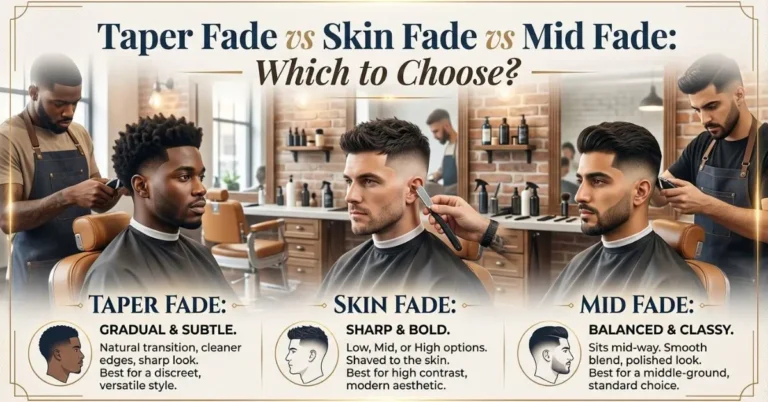
A taper blends the hair shorter near the neck and ears while leaving some hair showing. A skin fade goes all the way down to bare skin, usually with a zero guard and blade work, so it looks sharper and stands out more.
| Feature | Taper Fade Styles | Skin Fade |
|---|---|---|
| Shortest length | Hair still visible (half guard or higher) | Bare skin (zero guard, blade work) |
| Contrast | Low to moderate | Moderate to high |
| Look | Neat, classic, professional | Fresh, bold, fashion-forward |
| Touch-up | Every 3 to 4 weeks | Every 2 weeks |
Choose taper fade styles if you want a neat cut that lasts. Choose a skin fade if you want stronger contrast and don’t mind frequent visits.
A full fade also blends higher and shorter than a taper, so the taper fade vs full fade choice comes down to subtlety versus impact.
👉Read More: Taper Fade Haircut
Low, Mid, and High Taper Fade Styles Explained
Where the blend starts changes the whole feel of the cut. All three are taper fade styles, but each gives a different level of contrast.
Low taper fade: The blend starts just above the ears and stays close to the natural hairline. It is the softest option and grows out the cleanest. If you have never had one of these taper fade styles before, start here. It works for school or work, and a low taper lasts three to four weeks.
Mid taper fade: The blend starts around the temples. It gives more contrast and a sharper, more modern shape. It is the most popular height because it sits between soft and bold. Expect a clean-up every two to three weeks.
High taper fade: The blend starts closer to the top of the head. It creates strong contrast, pulls the eye upward, and adds height on top. It makes the face look longer, and it needs a touch-up about every two weeks.
Not sure which one to pick? Say “start low and we can go higher if needed.”
👉Read More: Taper Fade
Best Taper Fade Styles for Men

Each of these taper fade styles pairs a clean fade above the ears and nape with a different top.
Taper Fade Cut and Textured Taper Fade
The classic taper fade cut has a short, textured top, a smooth fade at the nape, and a natural matte finish. Textured layering and light tousling add movement.
Taper Fade Short Hair and Taper Fade Back
A tight fade around the temples blends into neatly trimmed short hair. From the back, the fade starts at the neckline and rises smoothly toward the crown, which shows the blend clearly.
Taper Fade Long Hair
Longer, tousled layers sit on top while the fade sharpens the sides. Use matte-finish cream or sea salt spray for a relaxed, lived-in look.
Taper Fade Straight Hair and Side Part
Straight hair shows clean lines and sharp detail. A neatly combed top with a hidden part or soft side-sweep gives a refined finish.
Taper Fade Curly Hair, Wavy Hair, and Perm
Curls and waves add volume and movement on top while the fade keeps the sides tidy. A perm gives tight, defined curls. Use curl cream or mousse for definition.
Taper Fade Fluffy Hair and Blowout

Airy volume sits on top with a clean fade below. Blow-dry upward and outward with volumizing mousse, then finish with matte clay.
Taper Fade Fringe, Messy Fringe, and Textured Fringe
A forward fringe adds a youthful edge. The messy version is tousled, and the textured version is choppy and layered. Style forward with matte clay or lightweight styling cream.
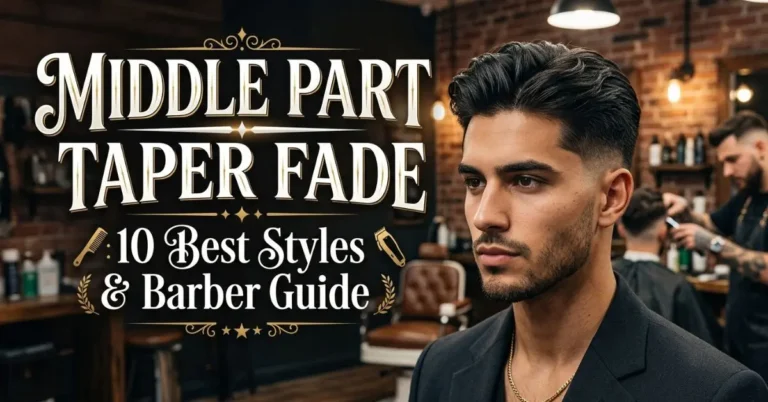
Taper Fade Middle Part
A center part frames the face symmetrically. It suits fashion-forward men.
Taper Fade French Crop, Crew Cut, and Buzz Cut
The French crop has a forward-swept fringe. The crew cut is short, clean, and athletic. The buzz cut has even length on top, needs almost no product, and looks polished with a little beard oil or moisturizer.
Taper Fade Mohawk and Faux Hawk
The mohawk has a bold strip of spiked volume down the center. The faux hawk is softer, with a lifted textured center. Use firm-hold gel or matte clay for definition.
Taper Fade Mullet
Sharp tapering above the ears meets longer, layered hair at the back. It is bold, edgy, and trend-setting.
Taper Fade Quiff and Pompadour

The quiff lifts the front for a fresh, modern shape and works best with a mid to high taper. The pompadour brushes hair up and back for height and pairs well with a mid taper. Use a blow dryer and strong-hold or medium-hold pomade.
Taper Fade Slick Back and Comb Over
Both are smooth and professional. The slick back has a glossy finish and a gentleman feel with a low taper. The comb over has a clean side part and suits mature, professional men.
Taper Fade Edgar
A blunt, straight fringe with a tight fade gives a bold, structured shape.
Taper Fade Afro and Dreads
A rounded afro keeps natural texture full while the fade sharpens the neckline. Dreads look structured against a clean fade. Use moisturizing curl cream, locking gel, or oil.
Taper Fade Asian and Blonde
For Asian hair, a sleek straight top with a soft, blunt fringe works well. Blonde taper fade styles use golden blonde, honey, platinum, or ash-brown tones. Auburn, chestnut, and dark brown add richness, and subtle highlights add depth.
Taper Fade Styles with a Beard
A taper fade with a beard sharpens your whole look. The key is blending the sideburns into the taper so the haircut and beard look connected instead of separate. A full, well-groomed beard, a goatee, or light stubble all work.
Face shape matters here too. Round faces look better with sharper beard lines that add shape. Square faces look better with softer beard edges that balance a strong jaw. Beard shaping and blade edging keep the lines crisp, and beard oil or balm keeps facial hair soft.
Tip: when you touch up your taper fade, clean up your beard too. If one grows faster than the other, the look gets messy between visits.
How to Find Your Face Shape
You don’t need to draw lines on a mirror. Use these basics:
- Oval: Slightly longer than wide and balanced.
- Round: Full cheeks, soft jaw, and similar width and length.
- Square: Strong jaw and wide forehead.
- Oblong: Much longer than wide, with a slimmer chin.
- Heart: Forehead wider than the jaw.
- Diamond: Cheekbones are the widest part.
A face shape detector can help, or bring a photo and let your barber match it.
Best Taper Fade Styles for Each Face Shape
Picking the right taper height is the difference between a cut that looks good and one that looks made for you.
| Face Shape | Best Taper Height | Why It Works | What to Avoid |
|---|---|---|---|
| Oval | Low, mid, or high | Balanced proportions give freedom | Nothing specific |
| Round | Mid to high | Adds vertical length and sharpness | Low tapers that add side width |
| Square | Low to mid | Softens the jawline | Overly sharp lines that amplify angles |
| Oblong | Low to mid | Side volume adds width | High tapers that elongate further |
| Heart | Low to mid | Keeps attention off the wide forehead | Very tight sides with no fringe |
| Diamond | Mid to high | Draws the eye up and highlights cheekbones | Heavy volume that widens the mid-face |
If your face is oval, nearly any of these taper fade styles will work. For round faces, ask for more length on top and a tighter fade at the temples to create height and structure.
How Hair Texture Changes Taper Fade Styles

Each hair type reacts differently, so tell your barber your texture and they can shape the blend.
- Straight hair: Clean lines and sharp detail, but it can look flat on top. Matte clay or texture paste adds grip and shape.
- Wavy hair: Natural movement makes the blend look smooth. Light cream or sea salt spray brings out the wave without weight.
- Curly hair: Volume on top looks great with tapered sides. Your barber may adjust the blend based on how the curls sit. Avoid heavy gels that flatten curls, and use curl cream to keep shape.
- Coily hair: Holds shape well and gives taper fade styles a bold, clean look. Edges soften faster, so regular visits keep the cut fresh.
- Fine hair: Choose a low taper and use less product so the top looks fuller.
- Thick hair: A fade removes bulk, and thinning shears or texturizing can keep the sides from looking heavy.
Humidity and hot weather matter too. Heavy creams and gels weigh hair down, so lighter products work better year-round.
How to Ask Your Barber for Taper Fade Styles
A great cut starts with a clear talk before the clippers come out. A short grooming consultation helps your barber pick the right taper for your face, hair, and routine.
- Start with taper height. Say low, mid, or high.
- Bring a reference photo. A front and a side photo make things easier.
- Mention your hair type. Fine, thick, curly, or coily hair changes the guard choice and blending method.
- Describe the top. “Two inches on top, textured, styled forward” beats “short on top.”
- Ask about the neckline. Choose squared, rounded, or tapered. Many guys forget this detail.
- Name the sides. Say a half guard or higher for a visible taper, or a zero guard for skin.
Avoid vague requests like “just a fade” or “whatever looks good.” A guard size chart and a barber brief generator can help you prepare, and a barber tip calculator makes tipping easy.
How to Style Taper Fade Styles at Home
- Prep. Wash and towel-dry until slightly damp. Add sea salt spray for texture or mousse for volume.
- Blow-dry. Use a blow dryer and a round brush or your fingers. Direct the air up and back for quick volume. Use a diffuser or air dry for curls.
- Apply product. Work a small amount through with your fingers.
- Finish. Seal with hairspray or argan oil, and refresh with texture powder.
A matte finish suits textured styles, and a glossy finish suits slick backs and pompadours.
Best Products for Taper Fade Styles
- Matte clay or texture clay: Strong hold, matte finish.
- Molding paste or matte paste: Flexible, medium hold.
- Light pomade: Shine and control. Strong-hold pomade suits pompadours.
- Styling cream: Soft hold for fine, wavy, or curly hair.
- Curl cream: Defines curls and keeps moisture in.
- Mousse: Lightweight or volumizing lift.
- Firm-hold gel: For mohawks and faux hawks, but avoid heavy products that look stiff or greasy.
- Texture powder: Lift and a dry, natural finish.
- Sea salt spray: Beachy texture.
- Argan oil and leave-in conditioner: Tame frizz and add shine.
- Beard oil: Keeps facial hair soft.
How to Maintain Taper Fade Styles
How long your cut stays fresh depends on the height and how fast your hair grows.
- Low taper: Holds three to four weeks.
- Mid taper: Looks best with a clean-up every two to three weeks.
- High taper: Needs a touch-up about every two weeks.
Between full haircuts, a standalone line-up or edge-up takes about fifteen minutes and cleans your edges so the last cut looks fresh longer. Use a trimmer for the neckline and sideburns, wash regularly without product buildup, and moisturize your scalp. Booking regular visits is the easiest way to stay sharp.
Common Taper Fade Mistakes to Avoid
- Wrong fade line: The wrong height for your head shape throws off the whole look.
- Poor blending: Choose a skilled barber who creates smooth transitions.
- Vague requests: Details give you a cut that fits you, not someone else.
- Skipping upkeep: Missing visits ruins a clean fade.
- Heavy products: They look stiff and greasy and weigh hair down.
- Over-brushing curls: It causes frizz.
Are Taper Fade Styles Good for School and Work?
Yes. Taper fade styles are neat, low-maintenance, and fit most dress codes, so they work for school, the office, and a casual weekend. A comb over or side part suits professional men, a messy fringe suits teens, and beginners can start with a low taper.
Final Thoughts
Taper fade styles stay popular because they are clean, versatile, and easy to wear. Choose the taper height for your face shape, match the top to your hair texture, bring a reference photo, and keep up with regular touch-ups. With the right products and upkeep, your taper fade styles will stay sharp and modern.
FAQs:
What are taper fade styles?
Taper fade styles are men’s haircuts where the hair gradually gets shorter from the top down to the neckline, nape, and sideburns. Hair stays visible at the bottom, so the look is clean and neat without going all the way to bare skin.
What is the difference between taper fade styles and a skin fade?
Taper fade styles leave some hair showing near the ears and neckline, usually with a half guard or higher. A skin fade goes down to bare skin with a zero guard, so it looks sharper but needs a touch-up about every two weeks.
Which taper fade styles are best for my face shape?
Round and diamond faces suit a mid to high taper. Square, oblong, and heart-shaped faces suit a low to mid taper. Oval faces can wear taper fade styles at any height.
How do I ask my barber for taper fade styles?
Say whether you want a low, mid, or high taper, and bring front and side photos. Mention your hair type, describe the length and style you want on top, and choose a neckline (squared, rounded, or tapered). Avoid vague requests like “just a fade.”
How often should I touch up taper fade styles?
A low taper lasts three to four weeks, a mid taper looks best with a clean-up every two to three weeks, and a high taper needs a touch-up about every two weeks. A quick line-up between haircuts keeps the edges fresh.



3 Comments