
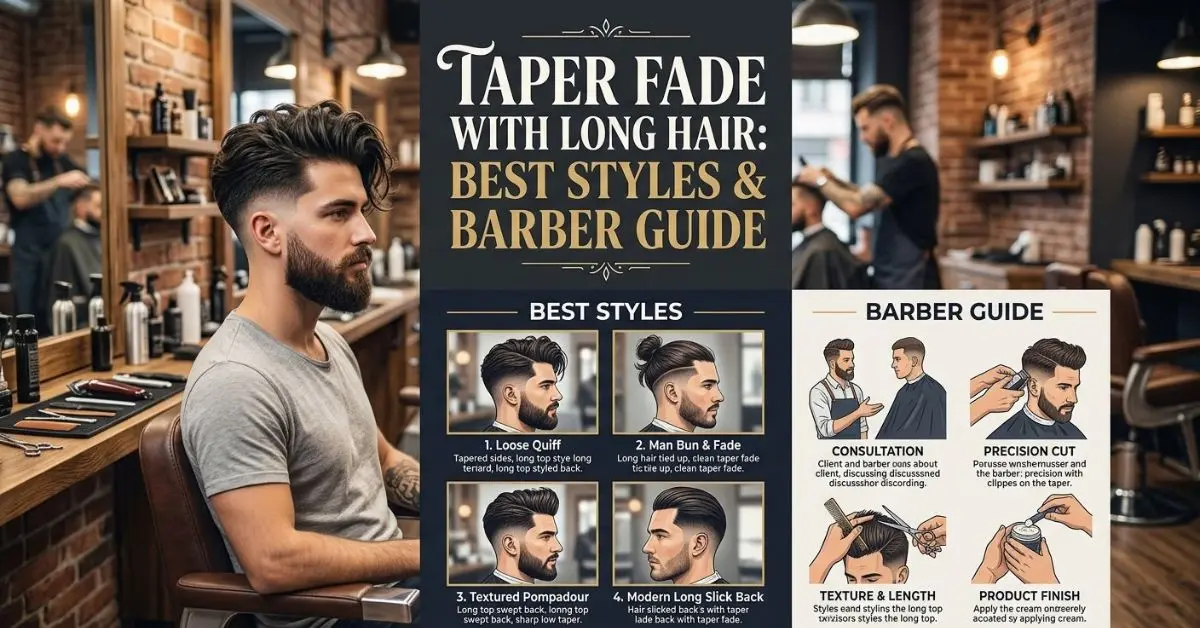
Taper Fade with Long Hair: Best Styles & Barber Guide
A Taper Fade with Long Hair keeps the length on top as the main event and cleans up the perimeter instead. The hair around the temples, sideburns, and nape graduates from long to short, starting around mid-height on the head. Everything above stays long enough to part, tie back, or wear loose.
This guide covers what the cut is, how it reads across textures, which taper height to ask for, how to brief a barber so you don’t lose length, and what upkeep looks like.
“Mid taper fade” is not a standardized term, so placement and shape matter more than the label. For the wider picture, see the complete low taper fade haircuts guide and the mid taper fade overview.
The Quick Version

- In a taper fade with long hair, the long top stays the focal point. The taper only cleans the temples, sideburns, and nape.
- Placement matters more than top length. Two people with identical length look different depending on where the graduation starts.
- Straight and wavy hair show the blend line. Curly and coily hair soften it.
- The perimeter needs a refresh every few weeks. The length on top can go months.
👉Read More: Taper Fade Buzz Cut
What Is a Taper Fade with Long Hair?
A taper fade with long hair is a cut where the temples, sideburns, and nape graduate from long to short while the top and the bulk of the sides keep their length. The taper cleans the outline, and the hair on top still defines the style.
Three things matter more than how long your top hair is:
- Placement drives the look. Where the graduation starts changes the whole cut.
- Perimeter tapering isn’t the same as shortening the whole side. The graduation concentrates around the temples, sideburns, and nape.
- The top stays flexible. Long hair can be brushed back, worn in loose curls, side-swept, or tied up, and the taper doesn’t dictate which.
The name is the weak point. The taper vs fade breakdown explains that people often mix the two up, and a mid taper haircut sits loosely between the low taper and high taper. Bring a photo.
👉Read More: Taper Fade Comb Over
Mid Taper Fade vs. Full Mid Fade: What’s the Difference?

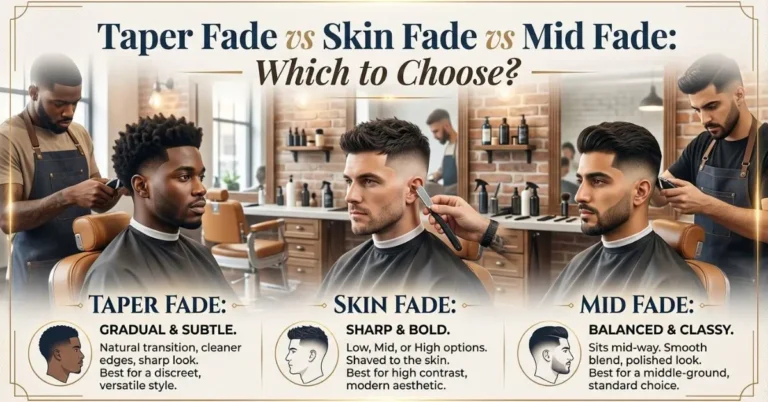
A mid taper fade concentrates the length change around the perimeter and usually stops well short of the skin. A full mid fade covers a wider section of the side and back and often blends down to the skin.
| Mid taper | Full mid fade | |
|---|---|---|
| Coverage | Concentrated near the perimeter | Wider blended area |
| Scalp exposure | Minimal to none | Often down to skin |
| Side length kept | More | Less |
| Look with hair down | Subtler | More noticeable |
A taper shifts length gradually and leaves the top and sides longer. A fade changes more abruptly and runs very short toward the bottom. That gradual quality is why a taper reads as the more conservative option for a long hair taper fade.
Is a Taper Fade Good for Long Hair?

It works well when you want a cleaner, more defined perimeter without giving up length or texture on top. The taper adds contrast around the edges while flow, curtains, curls, or tied-back styling stay intact.
It’s probably a good choice if:
- You want the long hair to stay the visual focal point.
- Your sideburns, temples, or neckline have started looking shapeless.
- You want contrast without going close to the skin.
- You wear your hair both down and pulled back.
Consider a lower or scissor taper instead if:
- Keeping maximum side length is the priority.
- You want the cut barely noticeable as it grows out.
- You’d rather not book as often as a mid placement requires.
The long hair low taper fade guide covers the softer, lower placement, and the low taper fade vs mid taper fade comparison lays the two side by side.
Lower placements keep more coverage, while higher ones create more contrast. Contrast cuts both ways: it looks sharp when fresh and makes regrowth obvious two weeks later.
👉Read More: Taper Fade Styles
Who Does a Taper Fade with Long Hair Suit?

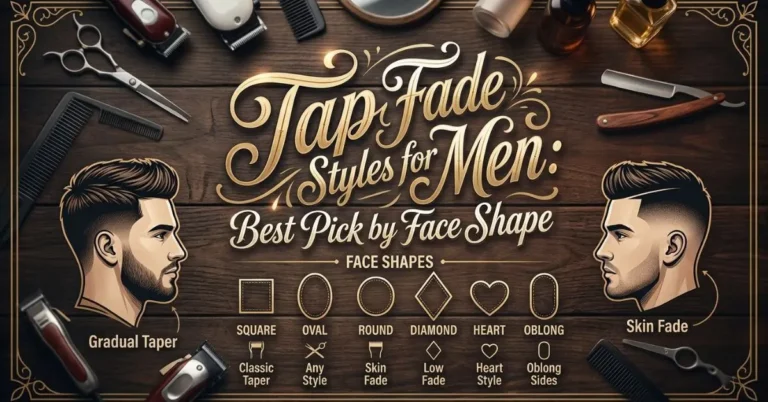
No single face shape or hair type is objectively best. Check these factors before your appointment:
- Texture: Straight and wavy hair show the blend line clearly. Curly and coily hair soften it.
- Density: Thick hair carries more bulk at the sides, so a mid placement removes more visible weight than it would on fine hair.
- Hairline and cowlicks: Uneven density or a strong cowlick near the temple affects how clean the transition looks.
- Styling habits: Tying your hair back puts the taper on display.
- Maintenance appetite: Mid placements need refreshing more often than low ones.
👉Read More: Taper Fade
Which Mid Taper Fade Styles Work Best with Long Hair?

The taper can look nearly identical from one haircut to the next. What changes is how the long top is cut, parted, and worn.
Taper Fade with Long Hair: Straight or Wavy
Straight hair shows the blend line and any weight imbalance clearly, since no natural texture disguises the transition. Waves blur it a little. See the mid taper fade wavy hair and mid taper fade for straight hair guides for more.
- Keep enough side weight above the taper so the transition reads as intentional.
- Say so if you don’t want undercut-level contrast.
- Layering controls heaviness better than the fade does.
Brushed-Back or Slicked-Back Long Hair
A slicked-back finish exposes the temple taper completely, so the blend has to be clean. It works best with enough length on top to hold the shape without heavy product.
Long Side-Swept Layers

Layers directed to one side soften the taper on that edge and show more of it on the other, so the cut reads differently depending on the angle.
Taper Fade with Long Hair: Curly or Coily
Curls and coils hold volume and shape above a cleaner taper. Curl pattern, shrinkage, and density all change how much length needs to come off. A barber working from a straight-hair template can remove more curl than intended, so read the mid taper fade for curly hair guide before you book.
- Preserve curl shape rather than thinning by default.
- Bring both a dry-curl reference and a stretched or styled one.
- Condition the full length and detangle wet hair gently with fingers or a wide-tooth comb.
Long natural curls with a clean perimeter: The curls stay full and shape the outline while the temple and neckline supply the contrast.
Long coils with a controlled temple and nape taper: A tighter taper gives coily hair a clear edge while the crown volume stays untouched.
Middle Part, Curtains, or Flow

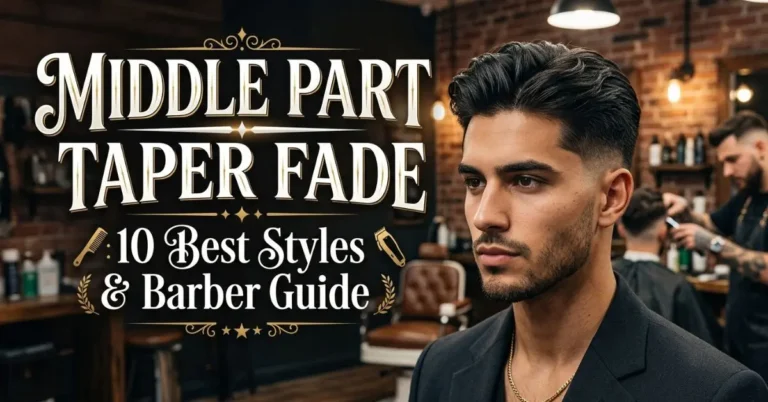
The taper is perimeter cleanup here, while the middle part or flow shapes the silhouette. Removing too much side weight undercuts how a part or curtain falls, so plan the two together. The low taper fade middle part guide and the mid taper fade middle part guide cover this in detail.
- Curtain-style middle part: Keep length near the part itself, not only on top, so the curtains fall properly.
- Layered flow with an ear-tuck style: Keep the taper low-key where the hair tucks behind the ear. A sharp transition there looks disconnected.
Tied-Back Styles: Man Bun, Ponytail, Braids, or Twists
Tying long hair back exposes the taper far more than wearing it down. Tell your barber how and where you tie it, since that changes how much length the sides need.
If your length lives mostly in the back, the mid taper fade mullet guide applies. The burst fade mullet curves the blend around the ear to protect length, and the drop fade mullet curves it down behind the ear.
Tension is the thing to watch. Tight buns, ponytails, braids, and locs can cause traction alopecia, a gradual hair loss from repeated pulling. Switch styles regularly, treat pain as a sign a style is too tight, and keep braids to six to eight weeks at most. Pulling that continues long enough can lead to permanent hair loss.
- Man bun or half-up: Confirm the tie position before the cut, since a high tie sits differently against the taper than a low one.
- Braids and twists: The taper frames the first row rather than blending into it. The low taper fade dreads guide uses the same perimeter-band approach for locs.
Mid vs. Low vs. High Taper: Which Height Works Best?

No height is universally better. The choice follows the silhouette you want and sets how often you’ll be back in the chair.
| Low taper | Mid taper | High taper | |
|---|---|---|---|
| Visual contrast | Lowest | Moderate | Highest |
| Side length kept | Most | Balanced | Least |
| Visible with hair down | Subtle | Clearer | Prominent |
| Upkeep | Longest between visits | Moderate | Shortest between visits |
| Main risk | Can read as too subtle | Removes more weight than expected | Can look disconnected from a long top |
A skin taper goes down to the skin at the bottom, while a tapered neckline shapes only the back edge. The low mid taper fade sits between the two lower placements, and the high taper fade guide covers the strongest contrast.
Taper Fade vs. Scissor Taper
A scissor taper skips clippers on the sides almost entirely. It gives the softest transition and the most retained length, but less definition than a clipper-based taper fade. A full mid fade suits you if the cut feels shapeless rather than merely untidy.
How Do You Ask a Barber for a Taper Fade with Long Hair Without Losing Length?

Communicate the placement, how much perimeter exposure you want, what has to stay untouched, and how you style the top. Then show a reference photo, because the phrase alone doesn’t describe one result across barbers.
- Show the overall silhouette you want, not just a close-up of a fade.
- Point to where the taper should start and end.
- State the minimum top and side length that must remain.
- Describe how you wear it: down, tied back, or parted.
- Decide the finish at the temples and neckline: natural, short, or close to the skin.
- Let the barber choose the blending technique and guard numbers, since guard numbers don’t translate reliably between shops.
Under-specifying is the main risk. “Mid” describes where the transition sits, not how much comes off, so a vague request can cost more length than intended.
What to Show and Specify at the Consultation
- Front, side, and back reference photos
- Desired temple height and neckline shape
- Sideburn treatment
- Top length and layering
- A connected or deliberately disconnected result
- How you style it day to day
- Beard blend, if relevant
- Any skin sensitivity, if you want a closer or razor finish
Neckline shape determines how the cut ages. A tapered neckline grows out most naturally, while rounded or blocked necklines need upkeep to hold their shape.
How Do You Style and Maintain a Taper Fade with Long Hair?
Maintenance covers two separate jobs: keeping the taper clean and keeping the long hair conditioned and shaped. Running one routine for both means the taper goes fuzzy or the length dries out.
For the taper: Tidy the neckline and sideburns with a trimmer between visits, and keep the perimeter dry while styling so the line stays crisp.
For the long hair:
- Shampoo the scalp rather than the full length.
- Put conditioner on the ends for fine or straight hair, and along the entire length for dry or curly hair.
- Detangle wet hair with a wide-tooth comb, working from the ends upward.
Daily Styling by Texture
- Straight or wavy: Light hold, air-dry where possible, and a comb for a defined line.
- Curly or coily: Leave-in conditioner, finger-styling or a wide-tooth comb, and less brushing.
- All textures: Limit blow-drying and irons, use low or medium heat, and apply a heat protectant.
How Often Should You Refresh the Taper?
A taper fade with long hair runs on two clocks: the perimeter needs attention every few weeks, while the length on top can go months.
| What you’re maintaining | Typical interval | What the appointment covers |
|---|---|---|
| Taper perimeter | 4–6 weeks (2–4 for a full fade) | Re-blending temples, sideburns, and nape |
| Edges only | 2–3 weeks | A shape-up on the hairline, temples, and sideburns |
| Long hair on top | 8–12 weeks | Shape, layers, and ends |
Expect the shorter end of the range with a mid placement, since higher contrast shows regrowth sooner. Hair grows roughly half an inch a month, and curl shrinkage hides regrowth until it suddenly shows. If you’re deliberately growing the sides out, these intervals don’t apply.
What Are the Downsides of a Taper Fade with Long Hair?
The real trade-offs are:
- Upkeep frequency: The perimeter needs regular refreshing.
- Losing more side length than expected: This is especially likely with a vague request.
- An awkward grow-out phase: The sides can look uneven until they catch up.
The haircut itself doesn’t damage hair. The risk comes from how the perimeter is finished and how the length is treated afterward, including tight tie-backs, heat, and rough detangling.
Final Thoughts
A well-planned taper fade with long hair gives you a sharp perimeter without sacrificing the length that defines the style. Choose the height that fits your texture and routine, bring clear reference photos, say exactly what length must stay, and book the perimeter refresh on its own schedule.
FAQs:
Is a taper fade with long hair a good idea?
Yes, if you want a cleaner perimeter without giving up length. The taper shapes the temples, sideburns, and nape while the top stays long enough to wear loose, tied back, or parted. It’s a weaker fit if keeping maximum side weight matters more to you than definition. In that case, a low or scissor taper is the safer choice.
What is the difference between a taper fade and a full fade on long hair?
A taper changes length gradually and concentrates the blend around the perimeter, usually stopping well short of the skin. A full fade covers a wider area and often runs down to the skin. On long hair, the taper reads as subtler and keeps more side length, while a full fade creates more contrast and a more noticeable shape when your hair is down.
How do I ask my barber for a taper fade with long hair without losing length?
Bring front, side, and back reference photos, and show the whole silhouette, not just a close-up of the fade. Point to where the taper should start and end, state the minimum top and side length that must stay, and explain how you wear your hair. Let the barber choose the blending technique, since guard numbers vary between shops.
How often should I refresh a taper fade with long hair?
The perimeter usually needs attention every 4 to 6 weeks, or every 2 to 3 weeks if you only want an edge-up on the hairline, temples, and sideburns. The long hair on top can go 8 to 12 weeks between trims. A mid placement tends to sit at the shorter end of the range because higher contrast shows regrowth sooner.
Does a taper fade with long hair work for curly or coily hair?
Yes. Curls and coils soften the blend line naturally and hold volume above a clean taper. The main risk is a barber removing more curl than intended, so ask them to preserve your curl shape instead of thinning by default. Bring both a dry-curl reference and a styled one, and condition the full length of your hair to keep it healthy.


2 Comments