
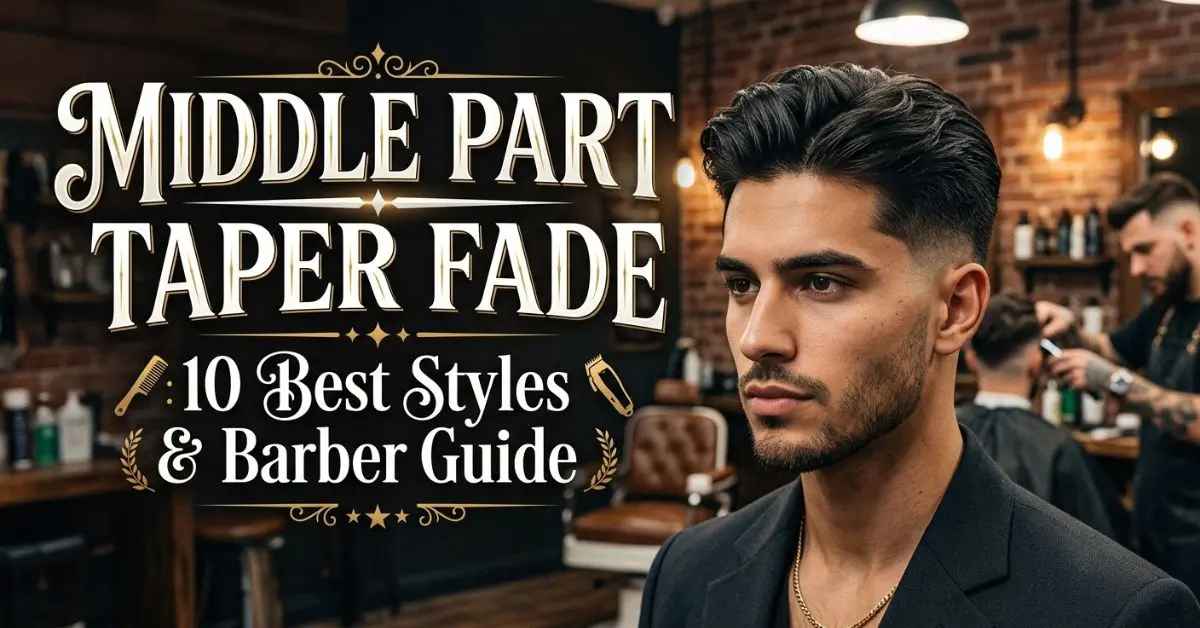
Middle Part Taper Fade: 10 Best Styles & Barber Guide
A Middle Part Taper Fade splits the top hair evenly down the center while the sides and back stay clean with a mid-height blend. It works with straight, wavy, curly, and coily hair, though each texture holds the part differently.
This guide covers what the cut is, the best middle part taper fade styles, how to choose one by hair type, face shape, and age, what to tell your barber, and how to maintain it.
What Is a Middle Part Taper Fade?

A middle part taper fade combines a centered part on top, where the hair falls evenly to both sides, with a mid-height taper that blends the sides and nape down toward the skin.
The part needs enough top length to hold its shape, usually two to four inches. The taper keeps the sides controlled without competing with the part for attention.
It’s a mid taper fade, so the blend starts around the temples and mid-sides. That sits between a low taper and a high taper, with more contrast than a low taper and less than a high one.
👉Read More: Taper Fade with Long Hair
Why the Middle Part Taper Fade Is So Popular in 2026
The middle part taper fade is popular because it looks modern, versatile, and polished without much daily effort once the part is trained. It suits every hair texture and photographs well from every angle. The clean sides also keep it from looking unkempt as the top grows out.
Pros and Cons of a Middle Part Taper Fade
| Pros | Cons |
|---|---|
| Distinct, styled look | Needs 2-4 inches of top length |
| Works with straight, wavy, and curly hair | The part takes time to train |
| Photographs well from multiple angles | Needs more daily styling than a short cut |
| Pairs with fringe, curls, or a slick finish | Cowlicks can make the part harder to hold |
| Clean sides balance the longer top | Needs regular taper touch-ups |
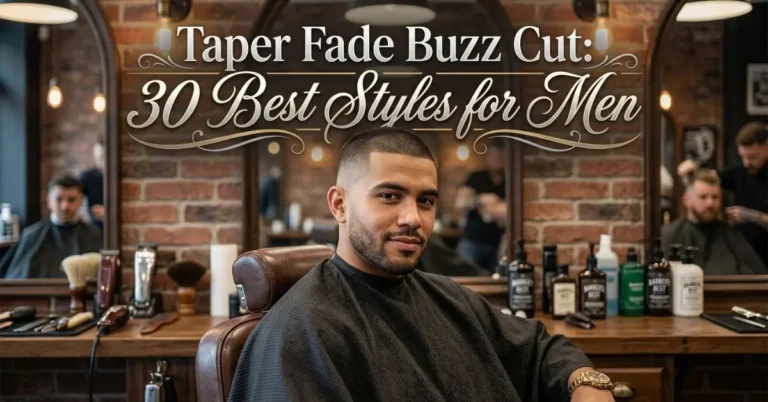
👉Read More: Taper Fade Buzz Cut
10 Best Middle Part Taper Fade Styles
These styles range from classic to textured and curl-specific. Each lists the hair type it suits best.
Classic Middle Part Taper Fade Styles

1. Classic Middle Part Taper Fade
A clean, symmetrical center part with hair falling evenly to both sides. The mid taper keeps the rest of the cut controlled and low-maintenance, which makes this the easiest first middle part. Best for: straight or medium-thick hair.
2. Slick Middle Part Taper Fade
The top is combed flat and slicked down on both sides of the part for a polished, formal finish. A light pomade gives the cleanest hold. Best for: straight hair and formal settings.
3. Wet-Look Middle Part Taper Fade
A water-based gel gives the part a glossy, wet-look finish that shows off the part line and holds all day without looking greasy. Best for: straight or fine hair.
Pro tip: Apply gel to damp, not soaking, hair. Too much water dilutes the hold, and the part loosens by midday.
👉Read More: Taper Fade Comb Over
Textured Middle Part Taper Fade Styles
4. Textured Middle Part Taper Fade
A matte texture clay breaks the top into a piecey, natural finish while the center part stays defined. It gives you styled hair without a slick or formal look. Best for: thick or wavy hair.
5. Messy Middle Part Taper Fade
The part is looser, with some strands crossing over for a relaxed, off-duty look. It reads less formal than a classic or slick version and takes less effort. Best for: medium to thick hair.
👉Read More: Taper Fade Styles
Curl and Wave Middle Part Taper Fade Styles
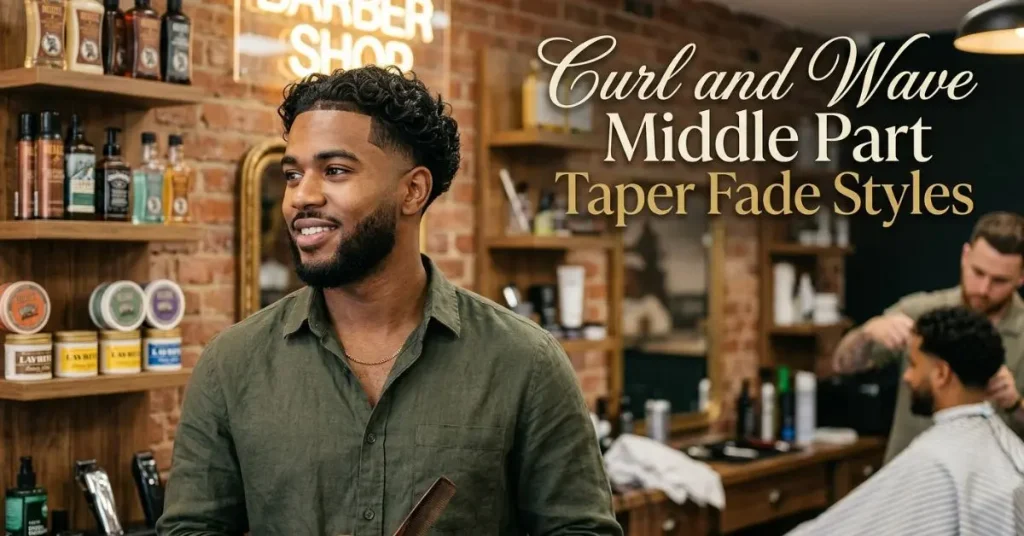
6. Curly Middle Part Taper Fade
Natural curls fall to both sides of the center part, and the taper keeps the sides from competing with the volume on top. Use a curl-enhancing cream and a diffuser to define the curls. Best for: curly or coily hair.
7. Wavy Middle Part Taper Fade
Natural waves add texture and movement to the part with little extra effort. A light sea salt spray enhances the wave pattern if it needs more definition. Best for: wavy hair.
Detail and Combination Middle Part Taper Fade Styles
8. Middle Part Taper Fade with Fringe
The center part splits the top while soft fringe pieces fall forward near the front. Best for: medium to long hair.
9. Undercut Middle Part Taper Fade
The sides are cut noticeably shorter beneath a longer, parted top, which gives more definition at the part line than a regular taper. Best for: straight or thick hair.
Pro tip: Ask your barber to keep the undercut length even all the way around. An uneven undercut makes the part look off-center even when it isn’t.
10. Two-Block Middle Part Taper Fade
The top stays noticeably longer than the sides, creating a visible step between the two lengths, with the middle part styled into the longer section. Best for: thick, straight hair.
👉Read More: Taper Fade
How to Choose a Middle Part Taper Fade by Hair Type

Texture decides how well the part holds, so match the style to your hair.
- Straight hair: It holds a part cleanly and shows the part line clearly. A light product keeps it from drifting through the day.
- Wavy hair: Waves add natural movement. A slightly longer top helps the wave pattern show, and a light texturizing spray adds definition.
- Thick hair: It holds a part well but may need weight removed on top. Ask your barber to thin the crown if the part feels bulky.
- Curly hair: Keep more length on top than you would for straight hair so the part reads through the curl pattern.
- Fine or thin hair: It struggles to hold a part without product. A lightweight volumizing product at the root helps, and a textured version often works better than a slick one.
- Coily hair: Keep a longer top and a soft taper so the natural volume and shape stay intact.
Best Middle Part Taper Fade Styles by Face Shape
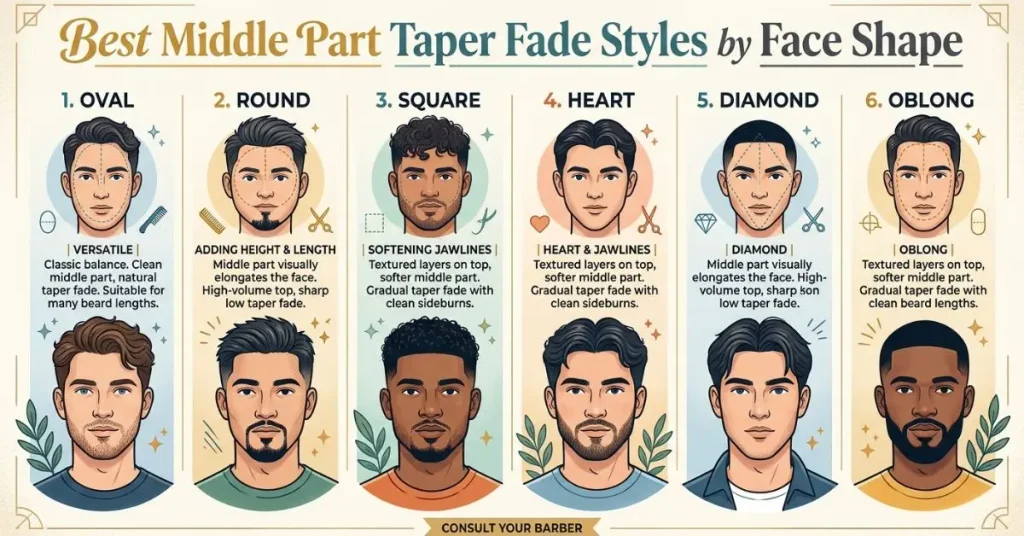
A middle part splits visual weight evenly, so the right version balances your proportions instead of exaggerating them.
- Oval face: Almost any middle part taper fade works, from classic to slick to textured.
- Round face: Keep height near the crown and add light texture. A flat, smooth finish can make the face look wider.
- Square face: An undercut or two-block version adds definition, and the strong jawline balances the symmetry of the part.
- Heart-shaped face: A flat part can widen the forehead. A textured or wavy middle part softens it.
- Long or oblong face: Moderate volume on the sides helps shorten the face visually. Avoid a completely flat, slicked-down finish.
- Diamond face: Add texture around the temples to soften prominent cheekbones. A curly or wavy middle part suits this shape well.
- Rectangular face: Moderate volume balances a long jawline better than a flat, close-to-the-head look.
Best Middle Part Taper Fade Styles by Age Group
- Teenagers: A textured or messy middle part works well for school. It needs less precision than a slick version and holds up through a full day.
- Young men: This is the easiest stage to experiment with texture, an undercut, or a two-block combination. A wavy or curly middle part reads well without feeling too formal.
- Professional men: A classic or slick middle part looks cleanest at the office. Keep the part precise and the taper conservative for daily workplace wear.
How to Ask Your Barber for a Middle Part Taper Fade
Start by telling your barber how much length you want to keep on top, since the part needs enough length to fall naturally. Then follow these steps:
- Bring a haircut reference photo and say where the part should sit.
- State your top hair length, usually two to four inches, and how you like it styled: slicked, textured, or messy.
- Say the taper should start around the temples and blend down the sides and nape.
- Choose your neckline preference: rounded, tapered, or square.
- Ask the barber to check the natural direction your hair falls before finalizing the part, since a part that fights your growth pattern won’t hold as well.
- Request a short barber consultation before the clippers come out.
For the taper itself, guard numbers matter most. The common sizes are 3mm (guard 1), 6mm (guard 2), 10mm (guard 3), and 13mm (guard 4). Most middle part taper fade cuts use a guard 2 or 3 on the sides, blending down to a 1 or skin near the hairline, while the top stays long enough to part.
Middle Part Taper Fade Video Guide and Tutorial
A video tutorial makes the technique easier to follow, especially for training the part into new growth. A good one shows how the barber sections the top, cuts around the part, and finishes the taper on the sides.
How to Style a Middle Part Taper Fade
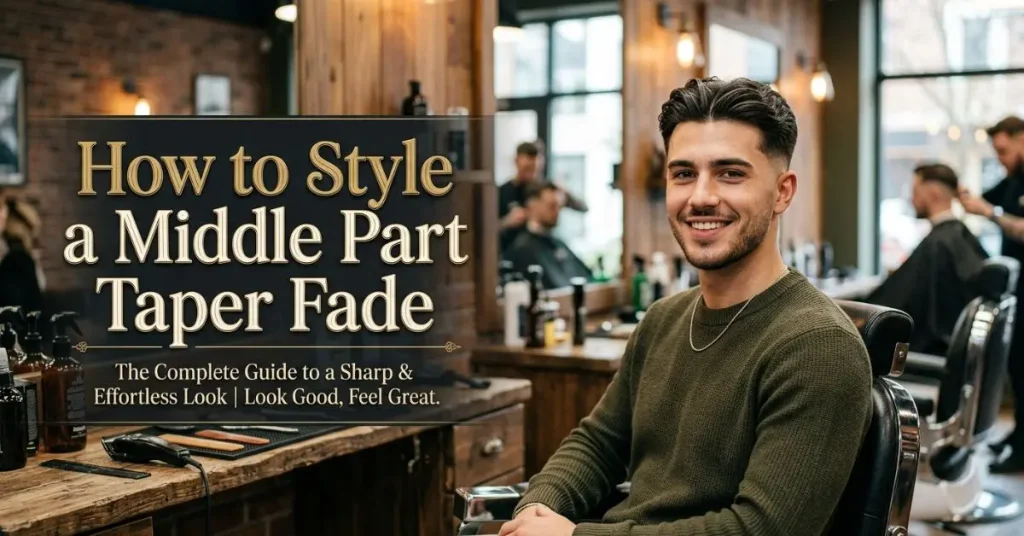
- Prep your hair. Wash, towel-dry, and detangle. Apply sea salt spray to damp hair for grip and light texture.
- Set the part. Comb or brush the part into place while the hair is damp, using your fingers or a comb to find the center line.
- Blow-dry. Use a low, cool setting and a vent brush or your fingers. Blow-drying is the best way to train a new part, because air-drying alone lets the hair fall back into its old pattern.
- Apply the right product. Use texture clay for a matte finish, pomade for a sleek look, molding paste for flexible hold, or styling cream for smooth control and frizz reduction. Texture powder adds lift at the roots.
- Lock it in. Finish with a light-hold hairspray for all-day hold.
Best Hair Products for a Middle Part Taper Fade
- Texture clay: Strong hold and a matte finish for textured versions.
- Molding paste: Flexible hold that is easy to restyle.
- Texture powder: Instant lift at the roots for flat or fine hair.
- Pomade: Shine and structure for slick and wet-look styles.
- Water-based gel: A glossy, strong hold that keeps the part line sharp.
- Sea salt spray: A pre-styler that adds grip and light texture.
- Styling cream: Light hold, smooth texture, and frizz control.
- Curl cream: Defines curls without stiffness.
- Argan oil: Softens dry or rough hair and smooths the ends.
- Clarifying shampoo: Removes buildup when hair feels greasy or flat.
- Hydrating conditioner: Restores softness so the part is easier to style.
Common Middle Part Taper Fade Mistakes to Avoid
- Cutting the top too short. A part needs at least two to three inches to fall naturally.
- Ignoring your natural growth pattern. Forcing the part against the direction your hair falls makes it harder to train.
- Using too much heavy product. Thick pomade or wax can make the part look greasy. Start small and add more only if needed.
- Skipping heat. A new part usually needs a blow-dryer to train the hair.
- Letting the taper grow out unevenly. A middle part draws attention upward, so an overgrown taper stands out. A touch-up every two to three weeks keeps the look balanced.
- Choosing a middle part without enough natural volume. Fine or thin hair can look flat. Add a lightweight volumizing product at the root, or choose a textured version.
How to Maintain a Middle Part Taper Fade
- Daily styling: Start with damp hair, set the part, and blow-dry on a low, cool setting, especially in the first few weeks after a fresh cut.
- Touch-ups: The taper usually needs attention every two to three weeks. The top can go longer between trims, but waiting too long softens the contrast between the clean sides and the parted top.
- Washing routine: Wash based on how oily your scalp gets rather than a fixed schedule, then condition to keep hair manageable. Use a clarifying shampoo when product buildup makes hair feel greasy or heavy.
- Home care: A good clipper and detail trimmer help you clean the neckline and sideburns between barber visits.
- Growing out: If you’re growing a shorter cut into a middle part, ask your barber how long it will take. A textured or wavy version works well in the meantime.
Middle Part Taper Fade vs Other Styles
The taper stays largely the same across these styles. What changes is the top.
- Middle part vs side part: A middle part splits the hair evenly down the center. A side part directs it to one side with a defined line and reads slightly more formal.
- Middle part vs slick back: A slick back pushes all the hair backward, while a middle part splits it to both sides and needs less length.
- Middle part vs regular mid taper: A regular mid taper can be worn unparted or lightly textured. Adding a middle part gives the same taper a more defined, styled top.
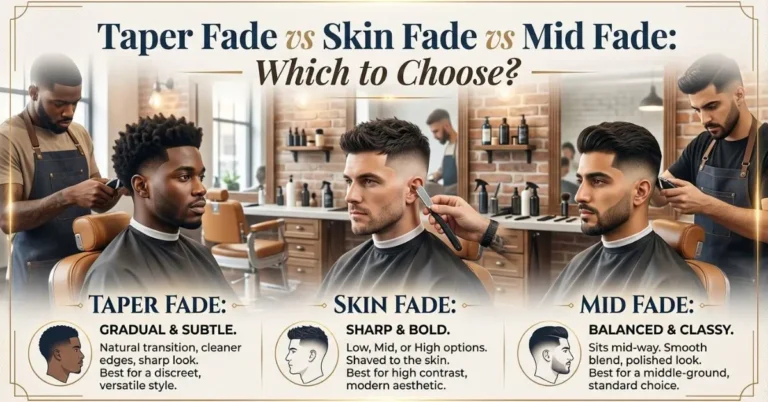
- Mid taper vs low taper: A mid taper starts around the temples for a bolder, more defined look, while a low taper begins near the ear and neckline for a softer blend.
- Mid taper vs high taper: A high taper starts closer to the crown for stronger contrast.
- Mid taper vs mid fade: A taper blends gradually and keeps more length. A mid fade exposes more skin with bolder contrast. Likewise, a temple fade focuses on the temples, while a taper blends along the whole perimeter.
Final Thought
A middle part taper fade works because it gives the top a distinct shape while the taper keeps the sides clean and low-maintenance. Choose your top length first, then let your barber build the taper around it.
Match the style to your hair type and face shape, train the part with a blow-dryer, and book a taper touch-up every two to three weeks. Save this guide and bring a reference photo to your next appointment so your barber knows exactly where to position the part.
FAQs:
What is a middle part taper fade?
A middle part taper fade is a haircut with a centered part on top and a mid-height taper on the sides and nape. The top stays long enough to fall evenly on both sides, while the sides blend gradually down toward the skin. It works with straight, wavy, curly, and coily hair.
How much hair do I need on top for a middle part taper fade?
Aim for two to four inches on top. Anything shorter than two to three inches can’t hold a part at all. Curly hair needs a little extra length so the part still reads through the curl pattern.
How do I ask my barber for a middle part taper fade?
Bring a reference photo and say where the part should sit. State your top length, say the taper should start around the temples and blend down the sides and nape, and choose your neckline shape. Ask the barber to check your natural hair direction before finalizing the part, since a part that fights your growth pattern won’t hold well.
How do I train my hair to hold a middle part?
Set the part on damp hair, then blow-dry on a low, cool setting while combing in the direction you want. Air-drying alone lets hair fall back into its old pattern. Repeat daily for the first few weeks, and use a light product such as pomade, gel, or styling cream to keep the part in place.
How often does a middle part taper fade need a touch-up?
The taper usually needs a touch-up every two to three weeks to keep the sides clean and the contrast sharp. The top can go longer between trims, but waiting too long softens the difference between the clean sides and the parted top.


2 Comments