
Low Taper Fade: 40 Best Haircuts for Men
A low taper fade is one of the most popular modern men’s haircuts, and for good reason. It is subtle, clean, sharp, polished and versatile. This guide covers the best low taper fade styles, low taper haircuts for men, how to ask your barber, how to style and maintain the cut, and which version suits your hair type and face shape.
What Is a Low Taper Fade?
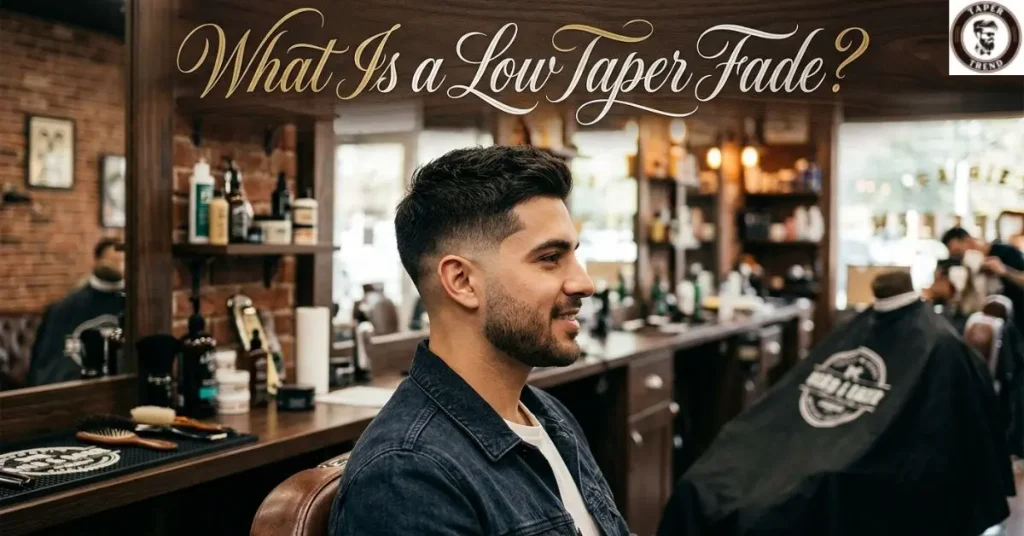
What is a low taper fade? It is a gradual blend that starts at the fade starting point, just above the ear, and moves from longer hair on top to skin-short sides. What is a low taper haircut? It is the same idea in a more natural form: the hair shortens slowly around the sideburns, sides and back, and the cut ends in a natural neckline.
The cut works because the transition is seamless. Your barber uses gradual blending to trim the sides and back so there are no harsh steps. The contrast is low, the lines are clean and defined, and the outline stays crisp around the temples, hairline, nape and neck.
👉Read More: Low Taper
Technical Breakdown
- Fade starting point: about 0.5 to 1 inch above the ear
- Blend zone: tight, usually less than an inch of transition
- Top length: 1-3 inches, depending on the style
- Neckline: natural, following your hairline
- Finish: a line-up, shape-up or edge-up if you want extra crispness
Is a Low Taper a Fade? Taper vs Fade

Is a low taper a fade? Yes and no, which is why people ask about the difference between taper and fade. A classic taper shortens the hair slowly and leaves some length at the edges. A fade cuts down to skin or near-skin and blends upward. The low taper fade takes the best of both, keeping the polish of a taper and the clean finish of a fade.
Low taper vs taper fade: a standard taper fade often cuts closer and higher, while a low taper leaves more length and a softer blend. The taper fade vs fade question mostly comes down to contrast. If you want subtle, go low. If you want a statement, go higher.
Low Taper vs Mid Taper vs High Taper
Fade height changes the whole look, so here is the low taper vs mid fade vs high fade comparison.
Low taper vs mid taper. A mid fade or mid taper sits higher, around the temples. It gives more contrast and structure while staying office-friendly. A low taper keeps the fade near the ears and neckline for a softer, more laid-back result.
Low taper vs high taper. A high fade or high taper starts above the temples. It gives maximum contrast and a bold, sharp finish. It suits guys who want their haircut to make a statement, especially those with angular features. The low taper is the safest option for first-timers.
Both mid and high versions need more frequent upkeep, because the grow-out shows faster against higher, tighter sides.
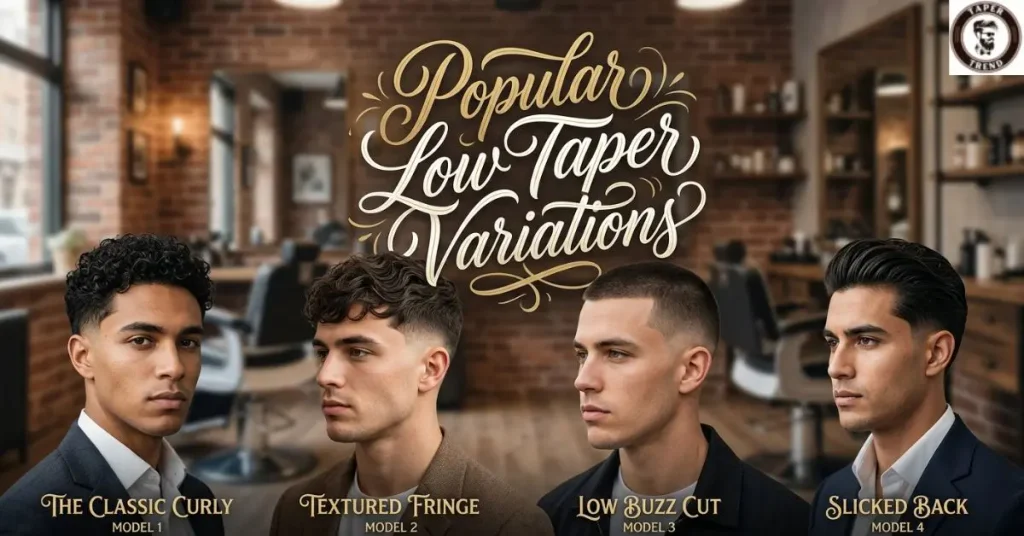
Popular Low Taper Variations
Drop Fade and Low Taper Drop Fade
The drop fade curves around the ear and dips lower at the back. The low taper drop fade applies that curve to a low taper. It follows your natural head shape, so you get a sculpted, contoured look with more definition than a straight line. Ask for a curve behind the ear so your barber knows where the line should fall.
Low Skin Fade and Low Taper Skin Fade
A low skin fade takes the fade down to bare skin while keeping it low near the ear. The low taper skin fade is the same idea with a taper-style blend.
The contrast is sharper, and it works well on thick or coarse hair where you want the sides to disappear. Skin vs shadow is a useful comparison: skin goes to bare skin, while a shadow fade leaves stubble.
Bald Taper Fade and Shadow Fade
The bald taper fade removes bulk at the sides and suits dense hair. The shadow fade keeps a soft stubble transition instead of skin, which gives a natural gradient with minimal upkeep. The shadow master is the “whisper, don’t shout” version, ideal for first-timers who are nervous about commitment.
Burst Fade and Low Taper Burst Fade
A burst fade flares in a circular pattern around the ear. The low taper burst fade pairs that shape with a textured top and a clean taper at the nape. It works well for curls, mohawks and textured tops.
Blowout Taper Fade and Low Taper Blowout
The blowout taper fade combines a low taper with airy volume on top. The low taper blowout is the casual, high-texture version that looks effortless. It is clean at the temples and lifted on top.
Other Named Fades
- Disconnected low fade: a visible gap between the top and the sides, popular with the creative type
- Skin-tight low fade: very short sides for the gym regular who wants zero fuss
- Conservative low taper: the safest option for client meetings
- Natural low taper: grows out gracefully, wash-and-go
- Versatile mid-low fade: sits between a low and mid fade, good for the weekend warrior
- Classic taper, textured low fade, soft low taper: the everyday staples
- Executive low taper, modern classic, textured drop, bold statement cut: the main style personalities, from corporate to creative
Taper Fade for Short Hair
A taper fade for short hair works because the fade does the heavy lifting. Keep the top at half an inch to an inch and let the taper blend it down. A little pomade through the fingers is all you need.
Best Low Taper Fade Styles and Low Taper Haircuts for Men

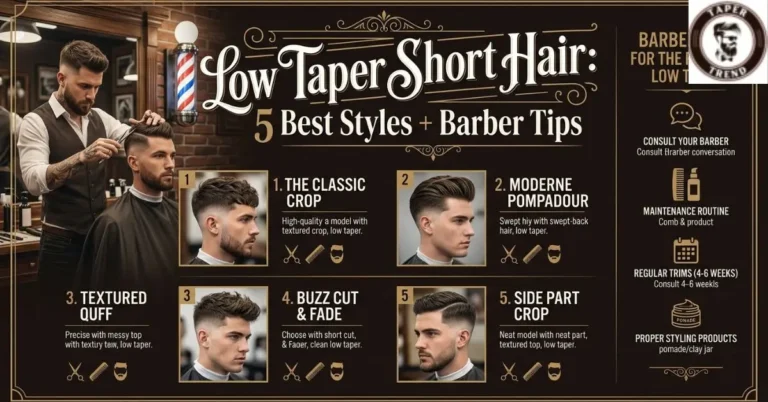
Here are the most popular low taper haircuts for men, grouped by what is happening on top.
Fringe and texture styles: The low taper fringe pushes the hair forward with soft edges. The low taper textured fringe and low taper messy fringe add choppy movement and a matte, tousled, messy texture.
The low taper blowout fringe brings loose volume. The low taper textured crop and low taper French crop keep the top short, thick and full of texture. A crop or textured crop also pairs well with a low taper Edgar, which is a blunt, structured fringe with crisp sides.
Longer and flowing styles: The low taper mullet blends retro flair with a soft taper. Low taper curtains frame the face with a middle part. The low taper long hair cut keeps long layers on top, and low taper fluffy hair is soft and airy. A low taper man bun lets longer hair be tied back neatly.
Sleek and classic styles: The low taper slick back and low taper pompadour are polished and timeless. The low taper comb over brushes the top across with definition. The low taper side part and low taper middle part add a clean, balanced look.
The low taper undercut, low taper crew cut and low taper buzz cut suit short, low-effort styling. Low taper straight hair gets a sleek, sharp finish.
Textured and cultural styles: Low taper curly hair and low taper perm show off bounce and defined curls. Low taper waves, or 360 waves, use a wave brush and durag to keep the pattern sharp.
The low taper afro, low taper dreads and low taper braids keep crisp edges around dense texture. Other popular searches include low taper black male, low taper Asian, low taper blonde hair and low taper back view.
Creative styles: The low taper mohawk concentrates volume down the center. Low taper design adds a hairline design for personality.
Best Fades by Hair Type

Your hair texture decides which version works hardest. The best fades by hair type:
- Straight hair: a classic low taper. Clean lines stay crisp, and the natural fall creates effortless volume.
- Wavy hair: a textured low fade. It works with your natural texture, and waves disguise the grow-out.
- Curly hair: a low drop fade. It follows your head shape and doesn’t fight your curl pattern.
- Tight curls: a shadow fade. The gradual blend complements dense texture, with no harsh lines.
- Thick hair: a bald taper fade. It removes bulk at the sides without thinning shears.
- Thin hair or fine hair: a soft low taper. It keeps coverage and avoids harsh contrast.
- Coarse hair: a low skin fade holds a sharp edge well.
Afro-textured hair and Asian hair both do well with a low taper. The cut keeps the shape neat while the natural texture on top stays the focus.
Low taper for thick hair is a strong choice because it removes weight at the sides. Low taper for curly hair and low taper for black men keep the curl pattern on top while the edges stay crisp. Low taper for Asian men works well because it adds shape and movement to thick, straight hair.
Best Low Taper for Your Face Shape
A good low taper supports face shape balance and symmetry.
- Round face: the best low taper for round face is one with structure and height on top. It elongates the silhouette.
- Oval face: balanced already, so most styles work.
- Square face: softens a strong jawline while keeping a crisp edge.
- Heart-shaped face: adds balance and keeps the sides clean.
- Diamond-shaped face and triangle face: a textured top and tidy sides balance the proportions.
- Angular features: higher fades emphasize angular features and jawline definition.
How to Ask Your Barber for a Low Taper Fade
This is where most guys go wrong. How to ask your barber for a low taper starts with being specific. Saying “give me a taper” is not enough. Here is what to say to your barber:
“I want a low taper fade. Start the fade just above my ear and keep the blend tight and subtle. Use a #1 into a #2 for the guard lines, scissor trim the top to 2 to 3 inches, and keep the neckline natural.”
Helpful tips for your barber consultation:
- Bring reference photos from the front, side and back.
- Specify fade height in inches, because “low” means different things to different barbers.
- Ask about clipper guards (#0, #1, #1.5, #2). A #1 at one barber shop can differ from a #1 at another.
- Ask whether they recommend a line-up, shape-up or edge-up.
- Book morning appointments and schedule your next visit before leaving.
A skilled barber uses the scissor-over-comb technique on top and clipper blending on the sides, guided by a fade comb, clippers and trimmers. This gives cleaner lines and softer transitions. If you need a pro, check for a barber near me or use a store locator.
How to Style a Low Taper
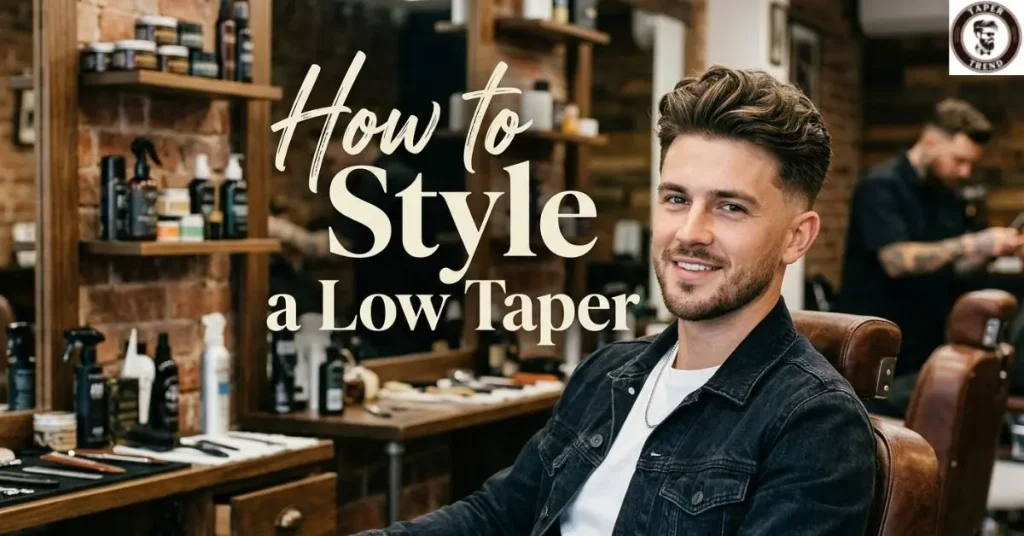
How to style a low taper is simple, and can I style a low taper at home? Yes. Follow these steps:
- Cleanse. Wash with a sulfate-free cleanser and follow with conditioner if your hair needs it. Towel-dry gently until slightly damp.
- Prep. Use a pre-styler, sea salt spray or thickening spray for root lift and body.
- Style. Choose your product for the finish you want (see below).
- Blow-dry. Use a blow dryer with a diffuser for curls, a vented brush for combed-back looks, or a round brush for volume. Finger-shaping works for casual, tousled looks.
- Finish. A hairspray (light hold) or a drop of oil locks it in.
Styling Terms and Finishes
For a matte finish, use clay. For a natural finish, use cream. For high shine, use pomade. Look for reworkable hold or flexible hold if you like to restyle through the day, or strong hold for control. Light control products work for fine hair.
The goal is volume, lift, movement, separation and definition, without heaviness. Done well, you get a sleek, polished finish, a lived-in finish, or airy texture that stays soft and touchable. Frizz control matters most for waves and curls.
Best Styling Products for a Low Taper
The best styling products for low taper depend on your texture and finish:
- Pomade and light pomade: sleek control and shine
- Clay pomade and matte clay: matte texture and hold
- Texture clay: strong, matte, defined layers
- Texture powder: instant lift and separation without buildup
- Texture spray: lift before blow-drying
- Molding paste: flexible, touchable control
- Styling cream: soft hold and a natural finish
- Curl cream and curl enhancing cream: define curls and maintain moisture
- Sea salt spray: a windswept, breezy look
- Thickening spray: volume for fine hair
- Strong hold gel: firm control for a comb over
- Argan oil and hydrating argan oil: shine and frizz control
- Clarifying shampoo: resets the scalp and removes buildup
Use cream on fine or wavy hair, and clay or wax on thick or straight hair. Avoid heavy products.
How to Maintain a Low Taper
How to maintain a low taper and how often to get a low taper are the two most common questions. A low taper needs a touch-up every 2-3 weeks, with barber visits every 2-4 weeks depending on how fast you grow out. Wait too long and you are starting over instead of maintaining.
Your maintenance level depends on hair type: straight and thin hair can stretch to 3-4 weeks, while curly, thick and tight-curl hair is best every 2-3 weeks. A low maintenance, low-maintenance haircut like the natural low taper suits wash-and-go routines.
Maintenance Calendar Checklist
- Days 1-5: peak sharpness. Style as usual and cleanse every few days.
- Days 6-10: the sweet spot. Watch for buildup and cleanse properly.
- Days 11-14: hair growth shows at the ears and neckline. Clean up with trimmers if you can.
- Week 3+: book your next cut.
Mistakes That Ruin Your Fade
- Overwashing with harsh shampoo and harsh sulfates can lead to a stripped scalp, losing natural oils and causing oil overproduction. The result is a greasy, undefined fade.
- Heavy petroleum-based products and too much product cause product buildup and fade blurring. Fade lines go soft.
- Hot water damage causes cuticle swelling and frizz at the blend.
- Aggressive towel drying creates micro-abrasions and a fuzzy fade. Practice patting dry instead of scrubbing.
- Skipping touch-ups ruins sharpness.
Scalp health and scalp hydration matter as much as the cut. A healthy scalp keeps your fade looking sharp for longer.
Low Taper Fade by Lifestyle
- Professional men’s haircut: a conservative low taper. It is office-friendly, ideal for client meetings, suits and client dinners. Zero rebellion, maximum polish.
- Creative type (agencies, startups): a disconnected low fade.
- Gym regular (active life): a skin-tight low fade.
- Trendsetter: a burst fade with a design.
- Weekend look: a natural low taper.
- Weekend warrior: a versatile mid-low fade.
- First-timers: start with a shadow fade.
- Teens and young guys: fringes, blowouts and textured crops give a youthful, edgy, confident look with minimal effort.
Clean Grooming and Natural Ingredients
A fade stays sharp when your grooming routine is built on clean grooming principles. Choose clean ingredients and natural ingredients: no sulfates, no parabens, a silicone-free formula, coconut-derived cleansers and essential oil scents.
These products are gentle on the scalp and keep buildup low. Many shoppers also care about sustainable, health-conscious products crafted with care, and look for a subscription or bundle to simplify the routine. Barbers and retailers can also look into wholesale options.
Final Thoughts
The low taper fade stays popular because it adapts to your hair type, face shape and lifestyle. Pick your variation, bring clear reference photos, use light products, keep your scalp healthy and book regular touch-ups. For the best products and a pro barber, shop now and use a store locator to find the right fit.
FAQs:
What is a low taper fade?
A low taper fade is a haircut where the hair gradually shortens from longer hair on top to skin-short sides. The fade starts just above the ear and blends smoothly down to the neckline. It looks subtle, clean and professional, and it is easy to maintain.
What is the difference between a low taper and a low taper fade?
A low taper shortens the hair gently and leaves some length at the sides and neckline. A low taper fade cuts closer, down to skin or near-skin, with a tighter blend. Both start low near the ear, so the look stays subtle compared to a mid or high fade.
How do I ask my barber for a low taper fade?
Be specific. Ask for a low taper fade that starts just above the ear, with a tight, subtle blend and a natural neckline. Mention the guard sizes (for example #1 into #2) and your preferred top length, usually 2 to 3 inches. Bring reference photos from the front, side and back.
How often should I get a low taper fade touched up?
Get a touch-up every 2 to 3 weeks to keep the lines sharp and the blend clean. Straight and fine hair can stretch to 3 or 4 weeks, while curly and thick hair looks best on a 2 to 3 week schedule. Waiting longer means the fade grows out and loses its shape.
Does a low taper fade suit all face shapes and hair types?
Yes, it is one of the most versatile cuts. It balances round, oval, square and heart-shaped faces, and it works on straight, wavy, curly, thick and thin hair. Only the top style changes, for example a textured crop, slick back or natural curls.



4 Comments