
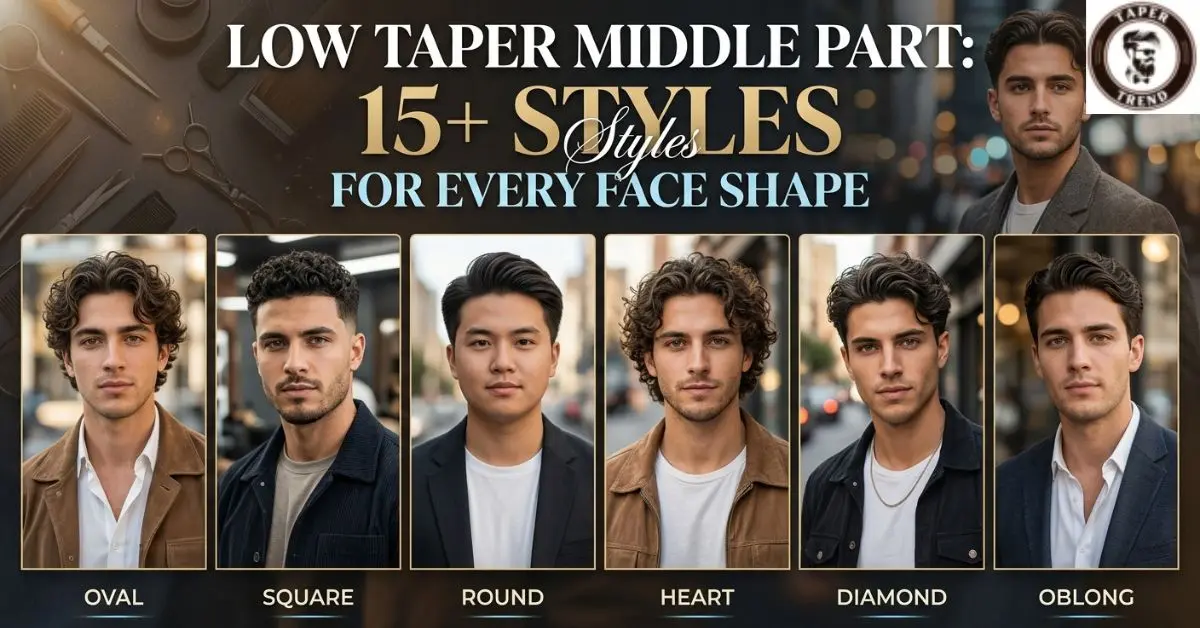
Low Taper Middle Part: 15+ Styles for Every Face Shape
The Low Taper Middle Part is among the most requested looks in the barbershop this year. It is a middle part low taper fade: a center part haircut on top over softly faded sides.
Social feeds pushed it into the spotlight, but its staying power comes from how effortless it looks. Whether you need haircut inspiration or a current cut for everyday wear, the low taper middle part gives you a clean look that stays low maintenance. This guide covers who it suits, how to ask for it, and how to keep it sharp.
The quick version
- A low taper middle part pairs a centre-parted top with a soft fade that starts near the ears and neckline.
- It reads office-friendly and relaxed, and it grows out more gracefully than a high fade.
- It works on straight, wavy and curly hair and on most face shapes.
- Aim for 3–4 inches on top so the part falls to both sides on its own.
What Is a Low Taper Middle Part?

A low taper middle part, also called a low taper fade middle part or a low taper with middle part, combines two ideas: a middle part on top and a low taper on the sides.
A middle part means the hair is split down the center instead of swept to one side. Sweep it over and you get a side part low taper fade. The center version gives a symmetrical shape, and once the top is long enough it looks like a soft curtain style.
A low taper describes where the shorter hair begins. “Low” means the gradual shortening starts around the ears and neckline rather than up by the temples, so the change stays subtle. That subtlety is why the low taper middle part feels neat without feeling fussy.
If you want to picture the base shape first, ask what a low taper fade looks like from every angle. The sides are clean and short, the top is longer, and the blend between them is smooth. Every low taper fade haircut shares this base. The middle part is what makes this version recognizable.
👉Read More: Low Taper Comb Over
Taper vs Fade: What’s the Difference?
People mix up taper and fade, but the gap is small. A taper shortens the hair gradually without showing much skin. A fade goes shorter and blends closer to the skin for a crisper edge. A taper fade haircut uses both: a soft taper higher up and a cleaner low fade near the bottom.
A natural taper leaves the skin mostly covered. A skin taper fades closer to the scalp for more contrast. On a low taper middle part, either works. Choose a natural taper for a relaxed finish or a skin taper for extra definition.
Why the Low Taper Middle Part Is Trending in 2026

Among trending men’s haircuts in 2026, the low taper middle part sits near the top. It belongs to a wider group of modern men’s hairstyles built around soft, wearable shapes rather than harsh lines.
- Contrast without drama: short, clean sides under a longer top add definition without the severity of high-contrast fades.
- Range: it looks right in a lecture hall and in an office, and it pairs with streetwear or something smarter.
- Staying power: the low taper sits closer to natural hair growth than a high fade, so the overall shape stays soft.
- Everyone can wear it: students, office workers and anyone who wants a polished but relaxed look can pull it off. It works as a professional haircut for men, as an office haircut for men, and as a school haircut for boys.
For guys who want a fade but not the drama of a high or skin fade, the low taper middle part is a comfortable middle ground. It feels trend-forward without going out of date after one trend cycle.
👉Read More: Low Taper Designs
Best Face Shapes for a Low Taper Middle Part
The low taper middle part adapts to most faces, but a few shapes get the most from it. Length, volume and taper height all shift the result.
- Oval: the easiest fit. Balanced proportions handle almost any length or volume on top.
- Round: this is the best hairstyle for a round-face man only with some lift. A flat middle part can widen the face, so add height up top to stretch it. Yes, a middle part suits round faces when you build a little volume.
- Square: looks sharp here. The softer top eases strong jaw angles, and a longer fringe frames the face well.
- Heart: keep some width at the temples instead of going sleek, to balance a narrower chin.
- Long: keep the top shorter and the taper tighter. Extra height only makes the face look longer.
If you aren’t sure which shape you have, you can find your face shape from a selfie before booking. It tells you whether a low height suits you.
👉Read More: Low Skin Taper
Low Taper Middle Part by Hair Type

Texture changes both the look and the effort it takes to style.
Straight Hair
Straight hair gives the cleanest low taper middle part. The part line stays crisp and the top falls flat and even on both sides. Work a light pomade or matte clay into slightly damp hair so the part stays sharp without looking greasy.
Blow dry briefly with a comb to set the direction. This is also why a low taper fade is good for straight hair: it needs very little styling.
Wavy Hair
Wavy hair brings a relaxed, undone finish and needs less product than people expect. The natural bend adds movement that suits a low taper fade for wavy hair. Use a texturizing spray or sea salt mist on damp hair, then air dry or finger style. Skip heavy creams, which flatten waves.
👉Read More: Low Taper Fade Back
Curly Hair
Curls give the low taper middle part its most personality. A curly low taper fade builds volume on top that plays off the clean, faded sides. Apply a curl-defining cream to soaking wet hair, then air dry to hold the pattern and control frizz. Don’t brush curls dry. It breaks up the curl pattern and the shape.
Thick Hair
Thick hair suits this cut, but it needs weight removed. Without it, the top can sit like a heavy block. Ask the barber to point cut or texturize the top, or add light layering, so it moves and lies naturally. If you are wondering about haircuts for thick hair, this is one of the easiest to adapt.
Fine or Thin Hair
Can thin hair pull off a middle part? Yes, with the right length. Too much length reads as flat rather than full. Keep the top short to medium and use a lightweight volumizing powder or mousse. This keeps a haircut for thin hair from collapsing. With thinning, a shorter top also hides the part line better.
👉Read More: Low Taper Fade
Choosing the Right Top Length
Length on top makes or breaks the cut. It decides how the middle part falls and behaves. Good length is also what separates a middle part low taper from a plain short fade.
| Length | Top measurement | What you get |
|---|---|---|
| Short | 2–3 in | A low-key part with little styling, subtle rather than a full curtain |
| Medium | 3–4 in | The common pick: long enough to part cleanly and add movement |
| Long | 4 in+ | A real curtain effect with side-swept movement, but more frequent styling |
So how long should hair be for a middle part? The best hair length for a low taper middle part is about 3–4 inches. The hair needs enough weight to fall to each side on its own. Too short and it stands up instead of lying down.
This is also why medium length hair with a fade, or a low fade with a long top, suits the style so well. Mens medium haircuts like this one are the easiest to wear.
Match length to density as well. Thick hair carries more length without looking heavy. Finer hair looks better kept shorter so it keeps its volume.
The sides should stay clean but not aggressively short. The low taper works best when it supports the top instead of competing with it.
👉Read More: Low Taper
How to Ask Your Barber for a Low Taper Middle Part
Clear communication is the difference between a good cut and a great one. Barbers work from specifics, not “something low-key.” If you wonder how to ask a barber for a taper, bring a reference photo. The same words can be read differently from chair to chair. In the chair, mention:
- Taper height: ask for the taper to start low, around the ears and neckline, not up by the temples.
- Top length: say you want enough length to part down the middle and style both sides.
- Blending: request smooth blending, not a hard line between the top and the sides.
- Finish: tell them whether you want a natural taper or a skin taper.
- Clipper settings: know your clipper guard numbers. A guard size chart shows what each guard number leaves, and the usual guard steps for a low fade.
A simple line covers what to say to the barber for a low taper: “I want a middle part with enough length on top to style both sides, and a low taper around the ears and neckline. Keep the fade clean but not too high.”
That handles placement, length and finish, which is usually enough for an experienced barber. Write it into a barber brief, or use a barber-ready photo, so the haircut to ask for is easy to show. Any barber haircut ideas you save should include the length on top.
Low Taper vs Mid Taper: Which Is Better?
The difference comes down to where the fade starts and how much contrast it creates.
| Low taper | Mid taper | |
|---|---|---|
| Fade starts | Near the ears and neckline | Around the middle of the sides |
| Contrast | Soft, natural transition | Sharper, more structured |
| Feel | Relaxed, low-key | Polished, deliberate |
| Best for | School, everyday wear | Office, trend-forward contrast |
Which is better, a low taper or a mid taper? It depends on how much contrast you want. A mid taper fade middle part is more structured. A high taper fade pushes the contrast even higher up the head, and a drop fade, burst fade or temple fade each change the fade line further.
For beginners, the low taper is the safest choice. It is more forgiving as it grows out, needs fewer touch-ups, and avoids the stark lines a mid or high fade shows after a couple of weeks. In the skin fade vs taper question, the taper is softer and the skin fade is sharper. Whichever you choose, the middle part stays the same.
Best Products for a Low Taper Middle Part

The right product depends less on the cut and more on your hair type and the finish you want. Among the best hair products for men, these suit this style.
- Lightweight cream: a natural, flowy look that controls hair without stiffness.
- Sea salt spray: texture and a tousled finish for wavy or straight hair. Sea salt spray for men gives grip and movement.
- Matte clay: hold without shine. Matte clay for men keeps the part in place without looking wet.
- Water-based pomade: a cleaner, defined part line. Pomade for men separates strands without going stiff or plastic.
- Mousse: volume for fine or thin hair and for curls that want lift without weight.
- Curl cream: curl cream for men defines the pattern and tames frizz on curly hair.
If your hair is fine, skip heavy, greasy products. They drag the top down and collapse the part. Less product, spread evenly, beats too much every time. Choosing the best products for a middle part low taper means matching the finish to your texture.
How to Style a Low Taper Middle Part at Home
Here is how to style a middle part, and how to style curtain hair, in six steps.
- Towel dry until the hair is damp, not soaking, so product spreads evenly and the part holds.
- Part the hair: this is how to part hair in the middle. Use a comb or fingers to split the top down the center from the hairline back.
- Blow dry both sides away from the part on low to medium heat, aiming airflow outward to train the hair.
- Add product: work in a small amount of cream, clay or pomade with your fingers.
- Finish with fingers or a wide-tooth comb. A fine-tooth comb makes the top look too neat.
- Keep it relaxed. Aim for a lived-in finish, not a helmet.
Straight hair mostly comes down to drying technique. Wavy hair benefits from partial air drying before texture spray. Curly hair is best styled wet with a curl cream and left alone while it dries. Wet hair holds a part better than dry hair, and damp hair is the sweet spot.
How Often to Maintain a Low Taper Middle Part
Upkeep keeps the cut sharp instead of growing into a shapeless mess. A good haircut maintenance schedule looks like this:
- Taper clean up: every 2 to 4 weeks, depending on how fast your hair grows.
- Top trim: every 6 to 8 weeks so the length stays consistent and the part keeps falling correctly.
- Neckline and sideburns: these grow noticeably between cuts. Do a quick neckline cleanup even if you are stretching the visit.
How often should you get a low taper touched up? Every 2 to 4 weeks keeps the line defined. Because it sits low, a fade grows out more gracefully than a higher one, but touch-ups still matter. People also ask how long a low taper fade takes to grow out. Most see the shape soften within a few weeks and lose definition by around the six-week mark.
Skip the upkeep and the line between the taper and the top blurs, so the shape starts to look accidental. A quick trim of stray neckline hairs at home, plus steady styling, holds it together between appointments. If you add a line-up or a beard trim, work out the tip on the cut and the extras before you pay.
Low Taper Middle Part Variations to Try
This is not one fixed look. Small changes give several directions.
- Classic: a clean, even part with moderate top length. Suits straight to slightly wavy hair.
- Textured: a choppy, piece-y top for a lived-in feel and a textured low taper middle part with more personality.
- Curly top: curls take over up top while the sides stay clean. This is the boldest version.
- Wavy curtain: a longer top with visible wave movement. Suits wavy hair that holds its shape.
- Longer fringe: extra length at the front for a softer, face-framing effect. Good on round or square faces.
- Subtle skin finish: a touch of skin near the bottom adds contrast while keeping the low placement.
You can also push the top into a curtain bangs effect for a softer front. Pick the variation that matches your texture and the styling effort you will realistically keep up.
Final Thoughts
The low taper middle part earned its spot for good reason. It is a clean, current cut that adapts to different face shapes, textures and routines without constant upkeep. Straight hair holds a crisp part, waves add flow and curls bring volume, so there is a workable version for most people.
The trick is matching the details to your features: top length, taper height and a styling routine you will stick with. Bring a photo, be specific with your barber and stay on top of maintenance. Done that way, the low taper middle part holds its shape well past a single trend cycle.
FAQs:
What is a low taper middle part?
A low taper middle part is a haircut with a center-parted top over sides that shorten gradually, starting low near the ears and neckline. It looks clean and relaxed, and it works well for both office and everyday wear.
How long should my hair be for a low taper middle part?
Aim for about 3-4 inches on top. That length is enough for the hair to fall to both sides on its own. Under 3 inches, the part tends to stand up instead of lying flat, and over 4 inches you get a full curtain effect that needs more styling.
Does a low taper middle part suit round faces?
Yes, with a little height. A flat center part can widen a round face, so ask your barber to leave some volume on top. That lift stretches the face and balances the shape.
How do I ask my barber for a low taper middle part?
Say where you want the taper to start (low, around the ears and neckline), how much length you want on top (enough to part down the middle), and whether you prefer a natural or skin finish. Bringing a reference photo helps the barber get it right.
How often should I maintain a low taper middle part?
Clean up the taper every 2 to 4 weeks and trim the top every 6 to 8 weeks. The neckline and sideburns grow out quickly, so a short touch-up between full cuts keeps the shape sharp.




2 Comments