
Low Taper with Beard: 12 Styles + Barber Guide
A Low Taper with Beard keeps the shortest hair low around the temples, ears, and nape. The sideburn then steps down in stages so scalp hair and facial hair meet without a hard line.
The top length stays independent, so a low taper with beard works under a buzz cut, a quiff, or loose curls. This guide covers 12 low taper fade with beard styles, how to brief your barber, and the honest upkeep.
The Quick Version
- A Low Taper with Beard stays low at the temples, ears, and nape, with the sideburn transition blending into the beard.
- Top length is independent of the taper, so it suits short, textured, and longer tops.
- It reads neat rather than severe, and regrowth shows first where the hair is shortest.
- Upkeep runs on three schedules: barber refresh, beard trim, and skin care.
What a Low Taper Fade with Beard Is

The phrase describes a placement, not a fixed style. The perimeter stays short and low, then blends upward into the top length. The beard is separate work.
A barber shortens the sideburn in steps so the last scalp hair and the first beard hair sit at a similar length. That beard connection and beard blend is what makes a low taper beard fade look like one deliberate cut.
👉Read More: Low Taper Middle Part
Where the Taper Sits and How It Meets the Beard
The taper placement starts just above the ears and along the nape, hugging the hairline rather than climbing toward the crown.
The sideburn taper does the connecting. Your barber works down it in shorter passes, so by the cheek the length matches the beard. Get that band wrong and you see an abrupt sideburn shelf, a ledge between haircut and beard.
Low Taper, Low Fade, and Beard Fade
These names overlap. A taper changes length gradually and keeps more hair. A fade drops off faster, often close to the skin. In the fade vs taper debate, “taper fade” is simply a mix of both words, so describe the finish instead of trusting the label.
Curve a low fade behind the ear and it becomes a low drop fade, which also connects well into a beard. A mid drop fade does the same from higher up.
👉Read More: Low Taper Comb Over
| Term | Where it’s shortest | What you get |
|---|---|---|
| Low taper | Above the ears and nape | Gradual step down, more length kept |
| Low fade | Same band | Sharper drop, often near skin |
| Beard fade | Sideburn into cheek or jaw | Facial hair work, independent of the cut |
Why Choose a Low Taper with Beard
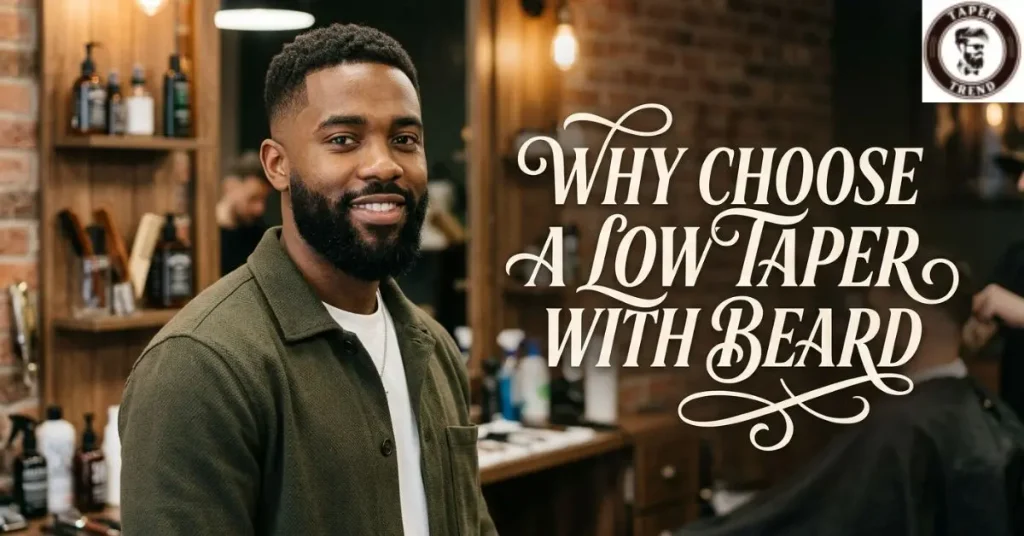
The appeal is restraint. A Low Taper with Beard offers subtle contrast and a continuous sideburn, and it is workplace and school appropriate.
Pros: neat rather than severe, a connected sideburn, works with short, textured, and longer tops, and grows out gracefully.
Trade-offs: regrowth shows first at the shortest point, a tight blend is hard to fix yourself, and the skin around the ears, neckline, and cheek line takes repeated close cutting.
Who a Low Taper Fade with Beard Suits Best
Fit depends on hair texture, beard density, and outline more than face shape.
👉Read More: Low Taper Designs
Hair Texture and Top Length
Straight hair shows guard marks most clearly, so the blend must be smooth. See our drop fade for straight hair guide for the curved version. Wavy hair hides small flaws and adds movement; our low taper fade for wavy hair guide goes deeper.
Curly and coily hair keeps volume if the taper stays low, which is why a curly low taper fade works well. For locs, a low taper fade dreads style keeps the loc bases untouched while the beard connects. A low taper fade afro follows the same low-perimeter logic.
Beard Density and Beard Length

A dense, even beard blends most predictably. Lighter or patchy beard growth works if the beard length stays shorter, sits lower on the cheek, or follows your strongest growth. Forcing a fade across a thin patch draws attention to it.
Face Shape, Head Shape, and Outline
Think in adjustments. Height on top lengthens a round face. Width at the temples balances a long face. Beard weight along the jaw and jawline squares a narrow chin. Unsure about your shape? A face shape detector can help you decide whether a low height suits you.
👉Read More: Low Skin Taper
Short, Clean-Cut Combinations
With little length on top, the taper and beard carry the look.
1. Buzz cut with low taper and stubble. Near-uniform top, tight taper, light stubble. Regrowth shows early. See our low taper fade buzz cut guide for guard lengths.
2. Crew cut with low taper and short boxed beard. A bit more length on top, with a defined cheek line and neckline. Safe for any workplace.
3. Textured crop with low taper and short faded beard. Texture pushed forward, sideburns stepping into a denser cheek and jaw. A low taper fade with short beard needs a minute of styling product.
👉Read More: Low Taper Fade Back
Textured and Longer-Top Combinations
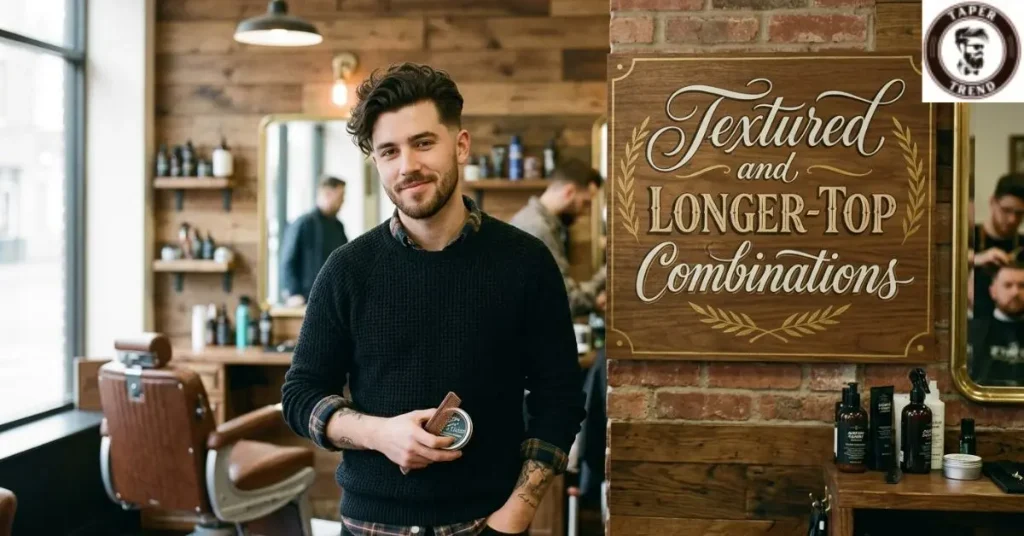
The perimeter stays clean while quiffs, side parts, and natural texture keep movement above it. The beard adds weight underneath.
4. Curly or coily top with a shaped beard. The curl pattern stays untouched. Two clean edges, the low perimeter and the beard outline, give the structure.
5. Wavy top with low taper and short beard. The longer top contrasts sharply with faded sides, so keep the beard short and evenly blended.
6. Quiff with low taper and full tapered beard. A low taper fade with full beard and faded sideburns balances the height above the forehead. It asks the most of a barber and a hairdryer.
7. Side part with low taper and beard fade. The most formal option. See our low taper fade comb over guide for the sideburn-to-beard run.
8. Blowout taper with beard. Outward volume held in check by a low perimeter. Add beard weight at the bottom or the head reads wide. Our low taper fade blowout guide covers the bulk problem.
👉Read More: Low Taper Fade
Beard-Led Variations and Edge Cases

9. Full beard with faded sideburns. Density builds from the temple down through the cheek and jaw as one gradient. Symmetry is hardest here.
10. Beardstache with low taper. Cheeks stay short while the moustache leads. Keep the taper subtle.
11. Goatee or circle beard with low taper. Clean or stubbled cheeks with a defined chin shape, useful when full cheek growth is not available.
12. Patchy-friendly blend or intentional separation. Shorten uneven growth to one length, shape around dense areas, or leave a deliberate gap between hair and beard. A clean break looks considered; a forced blend over thin growth does not.
How to Ask Your Barber for a Low Taper with Beard
The name of the cut leaves too much open. Use a short barber brief, or fill in a barber brief generator and show the barber brief card.
👉Read More: Low Taper
The Five Things to Specify
- Starting height. Low, around the temple, ear, and nape.
- Skin or shadow finish. Bare skin, near-bare, or a visible shadow taper.
- Top length and shape. Crop, curls, waves, side part, quiff, or blowout, not “not too short.”
- Beard length and outline. Cheek line, neckline, jaw weight, moustache, and chin length.
- Connected or disconnected sideburn. Run into the beard or stay separate.
Mention sensitive skin before anything is cut close. For a carved edge, our low taper fade design guide explains how a line-up works with a connected beard.
Reference-Photo Checklist
Bring front, side, and rear photos of someone with similar hair texture, top length, beard density, and hairline. Avoid filtered images. Point at what you like and what you don’t; “this, but less” is a useful instruction. Show the barber the reference photo before the clippers start.
What to Check Before You Leave the Chair
Check both sideburn transitions, the rear taper, beard symmetry, and where the neckline and cheek line land. Asymmetry is easy to miss under product and painful to live with for weeks.
How Barbers Cut and Blend It
A barber maps the shape, sets the baseline, and works up through longer guard lengths. Each guard number is blended with a rocking motion that pulls the clipper away from the scalp, which prevents guard marks. Then the top is connected, the beard is trimmed, and the perimeter is detailed.
- Consultation and map the shape.
- Set the low temple and nape baseline with the shortest guard.
- Work upward through longer guard sizes.
- Connect into the top.
- Trim the beard and define the cheek line and neckline.
- Blend the sideburn into the beard.
- Check symmetry and detail the perimeter.
For the facial half, start about an inch above the jawline one setting shorter than the beard, then shorten the setting for each band until the top of the sideburn meets the haircut. A clipper guard size chart helps you pick the right guard number for each band.
What You Can Safely Touch Up at Home
Stray hairs and an existing neckline can be tidied with a conservative guard, cutting against the direction of hair growth.
Rebuilding the blend or raising the taper is a barber job. You cannot see the back of your head, and a fade cut too high takes weeks to recover. Ask yourself: can I touch up a taper fade at home? Only the edges.
Low Taper with Beard Maintenance
Maintenance and upkeep split into three rhythms: a barber refresh for the taper, regular beard trim sessions, and daily skin care.
How Often It Needs Refreshing
No universal haircut interval exists. Growth rate, how short the shortest point is, and your tolerance for regrowth decide it. A skin finish grows out faster than a shadow taper, and a denser beard needs more shaping than stubble.
Check the sideburn transition at day 10 and day 20, and note which bothers you. That is your interval. If you ask how often to get a low taper fade, that test is the honest answer.
Preventing Razor Bumps, Irritation, and Dry Skin
Close cutting around the ears, neckline, and cheek line causes razor bumps (pseudofolliculitis) and ingrown hairs. Soften hair first with a warm damp washcloth or a shave after a shower.
Cleanse with a non-comedogenic cleanser, use shaving cream, shaving oil, or shaving gel, shave with the direction of growth, and finish with a cool washcloth. Replace a disposable razor after five to seven shaves.
For skin under the beard, a dermatologist-style skin care routine works: wash daily with a gentle cleanser, moisturize while skin is damp, and comb product through with a beard comb.
Use beard conditioner for acne-prone skin, beard oil for dry skin, and a fragrance-free non-comedogenic moisturizer for sensitive skin. Untreated razor bumps can lead to scarring, so see a dermatologist if they persist.
Three Mistakes That Make Hair and Beard Look Disconnected
- An abrupt sideburn shelf. Length drops in one step and leaves a ledge.
- Beard bulk at the temple. Heavy cheek hair against a tight taper creates an edge, not a gradient.
- Mismatched perimeter lines. Hairline, cheek line, and neckline shaped separately look like two haircuts stitched at the ear.
How It Compares with Similar Cuts
For a height comparison, read low taper vs low fade and low taper vs mid taper fade. Our mid taper fade with beard guide starts the same blend at the mid temple.
| Style | Transition | What you see |
|---|---|---|
| Low taper | Above ear and nape | Subtle, easiest to grow out |
| Low fade | Same band | Sharper drop |
| Mid taper | Partway up the side | Moderate contrast |
| High taper | Couple of inches above the ear | Bolder, more scalp |
| Drop fade | Drops below the ear | Curved, suits a beard |
| Burst fade | Semi-circle around the ear | Length kept at the back, common under a mullet |
| Skin fade | Down to bare skin | Highest contrast |
A drop fade with beard curves behind the ear, while a burst fade with beard carries the arc into the beard. See drop fade vs burst fade, the burst fade haircut guide, and taper low burst fade for the quietest curve. For more contrast, see high taper fade with beard and skin fade with beard. Remember that a drop fade needs upkeep to hold its contrast.
When a Disconnected Beard, Natural Sideburn, or Clean Shave Makes More Sense
Skipping the connection is a choice, not a compromise. It suits uneven sideburn density, reactive skin, or a preference for visible contrast. A low taper fade with disconnected beard or natural sideburns asks less of your calendar.
A low taper fade clean shave is another option if you want the haircut alone. For connected beard and line-up pairings, see low taper fade for Black men. A barber tip calculator can help you budget for the cut, beard trim, and line-up.
Final Thoughts
A Low Taper with Beard works because the placement is fixed while everything around it flexes. Keep the taper low, step the sideburn down to meet the beard, and choose any top from a buzz to a blowout.
Decide the top shape, shortest length, beard length, and sideburn connection, then keep the fade, beard, and skin schedules separate. Do that and your low taper with beard reads as one cut from hairline to jaw.
FAQs:
Can a low taper with beard work with a patchy beard?
Yes. Shorten the beard to one even length, shape it around your denser areas, or leave a clean, intentional gap between the sideburn and beard. A forced fade over thin growth draws attention to the patches, so a deliberate separation often looks better.
Should the sideburns always be faded into the beard?
No. A connected sideburn gives the smoothest look, but a natural sideburn or a visible separation also works. Skipping the connection suits uneven sideburn density or sensitive skin along the jaw, and it needs less upkeep.
How often should I refresh a low taper with beard?
There is no fixed interval, because it depends on your growth rate and how short the shortest point is. Check the sideburn transition at day 10 and again at day 20, and note which one bothers you. Most people need a refresh every two to three weeks, and a skin finish shows regrowth sooner than a shadow taper.
What should I tell my barber to get a low taper with beard?
Specify five things: keep the taper low around the temples, ears, and nape; whether you want a skin or shadow finish; your top length and shape; your beard length and outline; and whether the sideburn connects to the beard. Bring front, side, and rear reference photos that match your hair texture and beard density.
Is a low taper with beard appropriate for work or school?
Yes. The contrast is subtle, so it reads neat rather than severe. Pair it with a short boxed beard or a crew cut top for the most conservative look.




3 Comments