
55 Low Taper Designs: Side, Back & Freestyle Ideas
Low taper designs are one of the easiest ways to make a classic haircut feel personal. The low taper keeps the temples, sideburns, ears, and neckline clean, while a shaved line, curve, or geometric shape adds a custom detail.
If you have been searching for a low taper with design that looks sharp but still wearable, this guide covers placement, styles, barber wording, styling, maintenance, and cost.
What Are Low Taper Designs?

Low taper designs combine a low taper fade with a carved detail such as a single line, curve, zigzag, chevron, or freestyle pattern. The taper stays close to the natural hairline, so the haircut looks neat from every angle. The design then becomes the focal point.
The best low taper haircut designs depend on four things: where you want the design, how bold you want it, your hair texture, and how often you can visit your barber.
👉Read More: Low Skin Taper
Quick Overview: 5 Low Taper Designs to Consider First
| Style | Placement | Best For | Difficulty |
|---|---|---|---|
| Single temple line | Temple | First-time design | Easy |
| Double back lines | Back | Clean, sporty look | Moderate |
| Curved side design | Side | Wavy or straight hair | Moderate |
| Lightning zigzag | Side/back | Bold personality | Moderate |
| Freestyle nape art | Back/neckline | Creative custom look | Advanced |
Low Taper vs Low Taper Fade: What’s the Difference?
A low taper only shortens hair at the edges and neckline. A low taper fade removes more hair on the sides for a stronger contrast.
When people ask about the difference between a low taper and a low fade, the answer is simply the size of the faded area. Low taper designs usually work better with a classic taper because the shaved detail stays visible without a large faded section competing with it.
👉Read More: Low Taper Fade Back
Low Taper vs Mid Taper Fade vs High Taper Fade
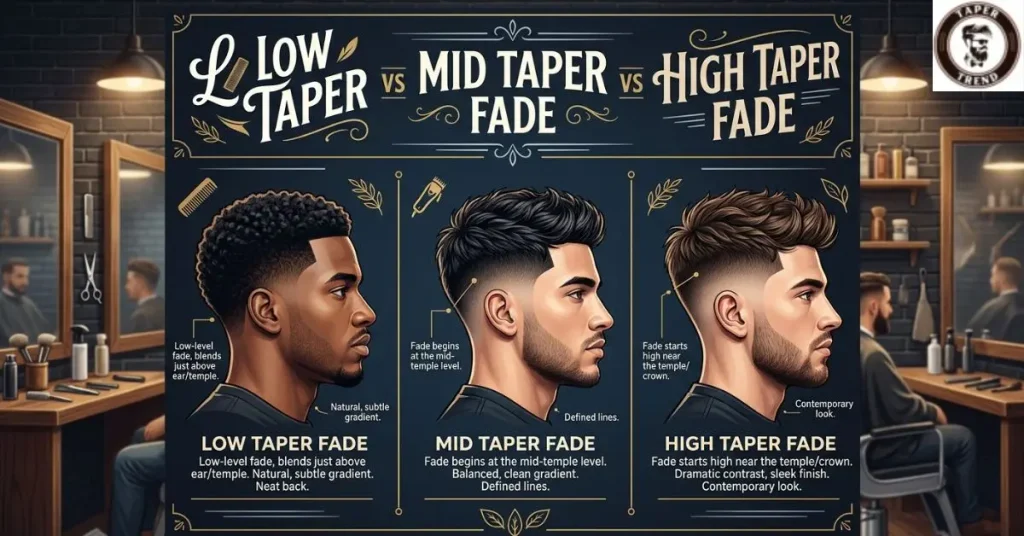
A low taper fade starts near the ears and neckline. A mid taper fade starts around the middle of the side of the head and is more visible. A high taper fade starts higher and creates the strongest contrast.
For designs, the low version is usually best. A high taper fade leaves less room for a design and can make it look crowded. A mid taper fade can work for bigger patterns. A low drop taper fade curves down behind the ear and suits curved designs, while a low temple taper fade focuses the blend around the temple, which makes it ideal for temple lines and arcs.
Other related options include the skin taper (blends down to skin), the shadow taper (a softer, darker blend), the burst fade (curves around the ear), and the drop fade.
Simple Side and Temple Low Taper Designs
Temple designs are the easiest entry point into low taper designs.
Single temple line. One narrow shaved line above the taper. It suits oval and square faces and works on straight, wavy, and curly hair. Keep it thin and clean.
Double parallel lines. Two lines add detail without becoming a full pattern. Medium and thick hair gives the best contrast.
Triple line stack. Three short lines create a stronger graphic effect. Keep the taper controlled so it does not climb too high.
Diagonal slash. One or two angled lines add movement. Round faces benefit from the directional angle.
Curved temple line or temple arc. A soft curve follows the head shape and looks organic. Wavy and curly hair pair well with it.
Mini chevron. Two angled lines meet in a subtle point. It looks sharper than a single line but stays compact.
Small diamond or corner cut. A tiny geometric shape gives a more artistic look. Precision matters, so keep it compact.
👉Read More: Low Taper Fade
Back and Nape Low Taper Designs

A low taper with back design stays subtle from the front and gets noticed from behind. A low taper with nape design works especially well when the top is left longer.
- Single back line: a clean horizontal line across the lower back.
- Double back lines: two parallel lines for a balanced, sporty finish. Symmetry is important.
- Short nape slash: a small diagonal mark placed to one side for an asymmetric look.
- Center V and double V: the neckline is shaped into one or two sharp points.
- Inverted V and back arrow: angled geometry that suits dense hair.
- Back crescent and nape wave: softer curves that work well on wavy and curly hair.
- Back diamond: a bold focal point that needs thick hair around it.
Ask the barber to adapt any back design to the curve of your head instead of copying a flat photo.
Geometric and Bold Low Taper Designs
If you want something louder, these low taper haircut designs stand out:
- Lightning bolt and double lightning bolt: sharp direction changes with high energy. They look best on thick, curly, or coily hair.
- Zigzag and double zigzag: repeated angles with a graphic feel. Leave enough space between lines so they do not merge as hair grows.
- Geometric triangle and stacked triangles: modern shapes that need steady symmetry.
- Geometric cross, diamond grid, geometric fan, and split chevron: detailed patterns that suit experienced barbers and dense hair.
Bold geometric designs fit casual and creative settings best. For conservative workplaces, stick to a single line or a small curve.
👉Read More: Low Taper
Freestyle and Custom Low Taper Designs
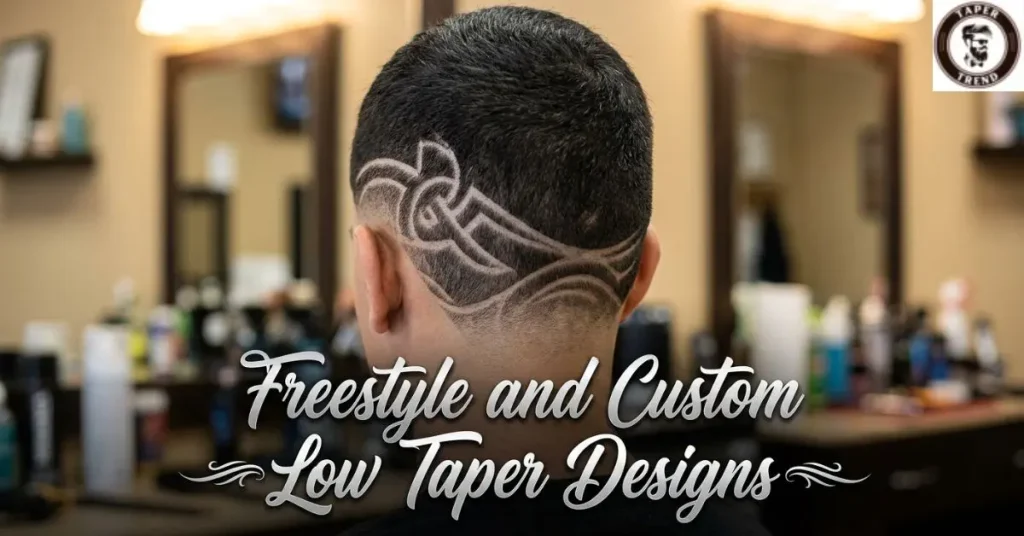
A freestyle low taper design gives your barber creative freedom. You choose a general direction, and the barber adapts it to your head shape and density.
- Freestyle side curve: soft and flowing, great for wavy hair.
- Freestyle back pattern: a custom nape design mixing curves, lines, and small shapes.
- Behind-the-ear secret design: a discreet detail that shows only when you turn your head.
- Side swoop: a curved line that follows the direction of the top.
- Three-point freestyle, wave-and-line combo, spiral, flame, wing: expressive options for confident, creative looks.
- Custom initial: a simple letter that stays readable as the hair grows.
Always show a reference photo, but let the barber adjust the pattern to your head.
Low Taper Designs for Different Hair Types
Low taper with design for curly hair. Curly hair creates strong contrast against clean lines. A single line, curve, or small geometric shape works better than a crowded pattern. Keep enough length on top for curls to form naturally, and use curl cream. A low taper fade for curly hair can also include a curly top with a back design, a curly fringe with a side line, or a broccoli-style top with a clean temple line.
Wavy hair. Curved designs look natural beside waves. Sea salt spray adds texture.
Straight hair. Straight hair gives the crispest outline for lines, triangles, and diamonds.
Coily and thick hair. Dense hair supports detailed patterns. This includes a low taper afro, a cropped afro, twists, dreads, and locs, where a low taper frames the sides without distracting from the length on top.
Fine hair. Choose smaller designs. Large shaved patterns can expose too much scalp.
Low Taper Designs with Different Top Hairstyles
The top style changes how the design reads. Some of the best pairings:
- Low taper fade short hair: a short textured top keeps attention on the design.
- Textured crop and French crop: neat, structured tops that suit chevrons, triangles, and double lines.
- Fringe and Edgar: a blunt front edge with a small side design nearby.
- Quiff and pompadour: extra height with a single curve or slash on the side.
- Slick back, side part, and comb over: polished styles that show off back and side designs. A hard part can double as a visual dividing line.
- Buzz cut: simple, low maintenance, and ideal for a single clean line.
- Mullet: a low taper frames the longer back, with a small nape design.
- Blowout and messy top: relaxed texture contrasts with a precise temple design.
- Top knot: pulls hair away from the sides so the design is fully visible.
- Long hair with low taper: keeps the front understated while the design stays hidden until you tie your hair back.
A low taper fade with beard also works well. Let the sideburn taper blend smoothly into the facial hair, and choose a small design so the whole look stays balanced. A clean line-up or shape-up along the front hairline keeps the edges sharp.
Best Low Taper Designs for Your Face Shape
- Oval: most designs work, so you can experiment.
- Round: directional designs like slashes, plus some height on top, create a longer visual line.
- Square: sharp geometric designs suit a strong jaw.
- Long: avoid too much height and keep the design lower.
- Heart: softer curves and smaller designs balance the wider upper face.
A low taper suits most face shapes because of its clean lines and balanced proportions.
How to Ask Your Barber for Low Taper Designs
Clear communication matters more than the design name. Avoid vague phrases like “just a fade” or “whatever works.” Mention the taper height, the shortest guard, where the design should sit, how much length to keep on top, and whether you want your natural hairline preserved.
Copy-and-paste script:
“I want a low taper around my temples, sideburns, ears, and neckline. Keep it low and do not let it climb into a mid or high fade.
Start the shortest area around a #0.5 or #1, then blend upward through #2 and #3. Keep my top length and texture. I want [design name] on the [side/temple/back/nape]. Please show me the placement before cutting.”
Useful add-ons:
- Simple design: “One clean line above the taper, and don’t change my front hairline.”
- Back design: “Keep it centered and adapted to the curve of my head.”
- Curly hair: “Don’t over-thin my curls.”
- Freestyle: “Use the photo as inspiration, but adapt it to my head and density.”
Bring reference photos and ask for feedback. Do not assume your barber remembers your last cut.
What Guard Should You Ask For?

There is no single correct answer. Most barbers start with a #0 or #0.5 at the shortest point and blend through #1, #2, #3, and sometimes #4. The result depends on the clipper, lever position, hair density, and the barber’s technique. What matters most is that the taper stays visually low.
How a Barber Creates Low Taper Designs
A professional process usually looks like this:
- Consultation: check hairline, density, growth direction, and design placement.
- Establish the taper: start around the temples, sideburns, ears, and neckline.
- Build the transition: use #1, #2, and higher guards, adjusting the lever to remove lines.
- Clipper-over-comb: remove weight above the taper without a harsh step.
- Shape the top: use scissors and point cutting for texture.
- Map the design: confirm position and scale from multiple angles.
- Cut the design: a detail trimmer creates precise lines, and a razor can add a closer finish.
- Refine the blend: check the taper from front, side, and back.
- Finish the hairline: clean the edges while preserving the natural hairline.
- Style and review: show the result and explain maintenance.
How to Style Low Taper Designs
Start with clean, towel-dried hair. Choose a product that matches your texture:
- Matte clay: texture and grip for straight or wavy hair and textured crops.
- Texture powder: light volume for fine hair.
- Sea salt spray: loose waves and body.
- Curl cream: definition for curly and coily hair.
- Molding paste or styling cream: soft, flexible control.
- Pomade: stronger hold for slick back and side part styles.
- Argan oil: a few drops tame frizz and add shine.
Use a fine-tooth comb for sleek styles, a vent brush for volume, and a wide-tooth comb for curls. Style the top first, and avoid heavy product that hides the design.
Color can add depth too. Honey, auburn, ash brown, or blonde highlights make texture stand out, though very high-contrast color can compete with a detailed design.
How Long Do Low Taper Designs Last, and How to Maintain Them
A low taper typically starts to lose its sharpness after 4 to 6 weeks. For crisp lines, plan a visit every 2 to 3 weeks, or every 2 to 4 weeks if you are comfortable with a softer look. Detailed designs fade faster because new hair fills in the shaved areas.
Between visits:
- Wash 2 to 3 times a week with a gentle shampoo.
- Keep the neckline and sideburns tidy with a precision trimmer, following the natural line.
- Do not try to recreate the design at home. One uneven pass can ruin the pattern.
- Take a photo of the finished design for future visits.
- Use leave-in conditioner or a little oil on dry days.
Common Mistakes to Avoid
- Taper too high: a “low” taper that behaves like a mid fade. Say clearly how low you want it.
- Ignoring density: a design that suits thick hair may look sparse on fine hair.
- Copying someone else exactly: head shape, hairline, and crown direction differ.
- Too many details: a complex top needs a simple design.
- Cutting the natural hairline too aggressively: it makes grow-out harder.
- Skipping maintenance: complex designs need regular touch-ups.
- Too much product: it makes the top stiff and hides the design.
How Much Do Low Taper Designs Cost?
Price depends on location, barber experience, and design complexity. A simple temple line usually costs little extra, while freestyle or geometric work can add more.
Average haircut prices by region:
- Small towns: $20–$35
- Urban areas: $40–$60
- High-end salons or big cities: $70+
Barbershop vs salon: barbershops are usually faster and more budget-friendly. Salons may charge more but often include a wash, scalp massage, and styling advice. Either way, you should get professional clipping, blending, shaping, and maintenance advice.
Final Thoughts
The best low taper designs are not always the biggest ones. A clean line, a soft curve, a small back design, or a carefully scaled geometric shape can add enough personality while keeping the haircut wearable.
Start with your hair texture, face shape, daily routine, and maintenance habits, then choose the placement. Tell your barber exactly how low the taper should stay, which guards you prefer, where the design should go, and whether your natural hairline should be kept. Save a few reference photos, and you will walk out with a low taper design that fits you.
FAQs:
What are low taper designs?
Low taper designs combine a low taper around the temples, ears, and neckline with a shaved or carved detail such as a line, curve, zigzag, geometric shape, or freestyle pattern. The taper keeps the cut clean and wearable, while the design adds a personal touch.
What is the best low taper design for beginners?
A single temple line is the easiest place to start. It is narrow, simple to maintain, and does not commit you to a large pattern. Once you are comfortable with it, you can move to double lines, a small curve, or a back design.
Are low taper designs good for curly and thick hair?
Yes. Curly, coily, and thick hair create strong contrast against clean shaved lines, so even a simple design stands out. Keep enough length on top for your curls to form naturally, and ask your barber not to over-thin the curl pattern.
How do I ask my barber for a low taper design?
Tell your barber how low the taper should stay, which guard to start with (usually a #0.5 or #1), where the design should sit (temple, side, back, or nape), and whether your natural hairline should be preserved. Bring a reference photo and ask to see the placement before the design is cut.
How often do low taper designs need maintenance?
Plan a barber visit every 2 to 3 weeks to keep the lines crisp. A low taper usually starts to lose its sharpness after 4 to 6 weeks, and detailed designs fade faster because new hair fills in the shaved areas. Avoid fixing the design yourself at home, since one uneven pass can ruin the pattern.




4 Comments