
Low Taper Fade Straight Hair: 25 Best Styles for 2026
A Low Taper Fade Straight Hair cut gives you clean sides, a sharp neckline, and a top you can style a dozen ways. Straight strands lie flat and uniform, so every length change in the blend looks crisp from any angle.
That is why the low taper fade straight hair combination is one of the most requested men’s haircuts right now. It looks polished, stays low-maintenance, and works in an office, at school, or on a weekend out.
This guide covers what the cut is, why it suits straight hair, the best styles, how to talk to your barber, and how to keep it fresh.
What Is a Low Taper Fade Straight Hair Cut?

A low taper fade is a clipper technique where the sides and back get gradually shorter toward the ears and neckline while the top stays longer. The “low” part means the blend sits close to the ears and nape instead of climbing the temples. On straight hair, the low taper fade creates a smooth, seamless transition with no curl or wave to break up the gradient.
The barber works the blend with clippers and a comb, so it reads as a soft gradient rather than a hard line. The hair follows the natural curve around the ears, and the neckline is cleaned up, either squared off or tapered.
👉Read More: Low Taper Long Hair
Why Straight Hair Suits the Low Taper Fade
Straight hair shows the fade more clearly than any other texture. Each guard change is visible, so the taper looks sharp and defined, and it stays that way for days after the cut. That precision works both ways: a clean blend looks excellent, but a rough transition shows just as easily.
Straight hair is also easy to style. It dries fast, holds products predictably, and lets you switch between a side part, a fringe, or a quiff without much effort. Because the fade stays low, the sides look neat rather than shaved, which suits professional settings.
One caution: fine or medium straight hair can sit flat on top. Ask your barber for light texturizing, point cutting, or graduation so the low taper fade straight hair style has built-in lift and movement.
👉Read More: Low Taper Short Hair
Low Taper Fade vs Low Fade vs Taper

These terms are often mixed up, even in barbershops.
- Taper: The hair gets shorter toward the neckline and ears without necessarily blending to the skin. It is the softest and most conservative option.
- Low fade: It blends down to the skin and starts slightly higher, with more contrast between top and sides. It looks sharper but needs more upkeep.
- Low taper fade: It sits between the two, combining a gradual taper with a clean fade near the ears and neckline.
For straight hair, the low taper fade is a balanced choice: subtle, soft, and modern. If you want more contrast, a mid taper or high taper is the next step up.
👉Read More: Low Taper with Beard
Best Top Styles for a Low Taper Fade Straight Hair Cut

The top is where the personality of the cut lives. These styles work especially well with low taper fade straight hair:
- Classic natural: Minimal product, neat sides, and a tidy finish that lasts all week.
- Textured fringe: A forward, choppy fringe worked with matte clay for separation and movement.
- Side part: Crisp, polished, and ideal for formal settings.
- Middle part: Medium-length hair split in the center, with a relaxed curtain-style flow.
- Quiff or brush-up: Extra height at the front, best on thicker straight hair.
- Short crop or French crop: The lowest-maintenance choice, styled forward with a matte finish.
- Slick back: A sleek, swept-back top with a polished shine.
- Buzz cut or crew cut: Very short, clean, and easy for school or work.
- Undercut or comb over: A bold contrast with a refined, classic edge.
👉Read More: Low Taper Middle Part
Short, Medium, and Long Variations
The low taper fade straight hair cut adapts to any top length.
- Short: The fastest version, with minimal contrast and a quick morning routine. It suits school and conservative offices, but styling room is limited.
- Medium (2 to 4 inches): The most versatile length. You can wear it natural, side-parted, textured, or swept forward.
- Long (over 4 inches): More expressive, with curtains, loose flow, or a slick back. It needs more product and time to look intentional.
Best Face Shapes for a Low Taper Fade Straight Hair Style
The low taper is forgiving, but small adjustments help.
- Oval: Handles almost any top length and part.
- Round: Add height with a quiff, brush-up, or fringe to elongate the face.
- Square: Soft styling like a textured fringe or loose side part softens a strong jawline.
- Heart-shaped: The low taper keeps balance and sharpens the jawline.
- Long: Choose moderate length and less height, such as a short crop or side part.
Hair density matters too. Thick straight hair blends cleanly but may need thinning on the sides. Fine straight hair needs some length and internal texture so it does not look flat.
👉Read More: Low Taper Comb Over
How to Ask Your Barber for a Low Taper Fade Straight Hair Cut
Clear communication does most of the work. Bring a reference photo, and be specific about the fade height, the top length, and the finish you want. Avoid vague requests like “give me a taper” or “not too short.”
Try this: “I’d like a low taper fade, kept low around the ears and neckline, with a soft, natural blend. Leave two to three inches on top and add some texture so it doesn’t sit flat. I have straight hair, so adjust the guard sizes if needed.”
How to Style a Low Taper Fade Straight Hair Cut
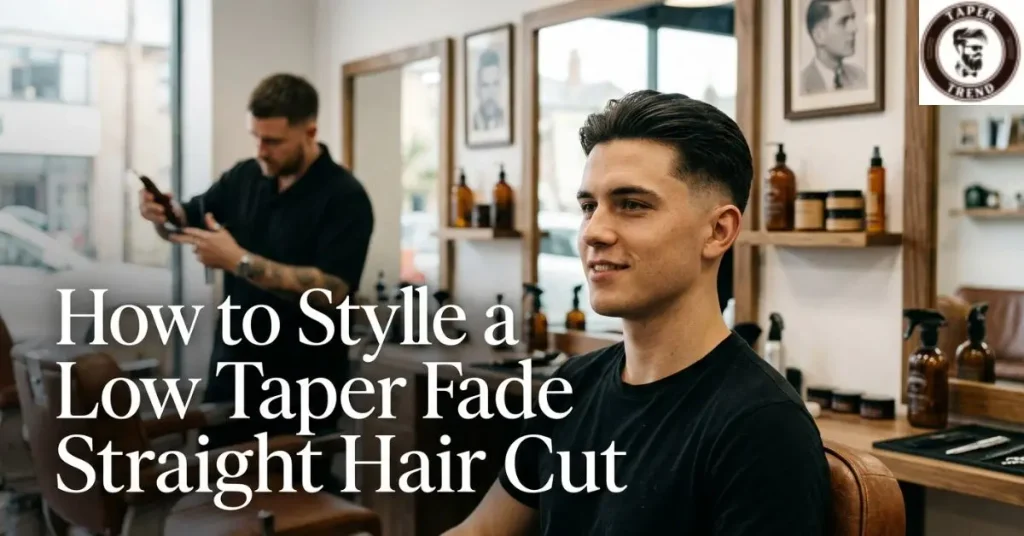
- Prep: Wash, then towel-dry until the hair is slightly damp.
- Add volume: Use a blow dryer on medium heat, lifting the roots with your fingers or a round brush.
- Apply product: Start with a small amount and work it through with your fingers. Use a fine-tooth comb for a side part or polished look.
- Finish: Seal with a light hold hairspray, and refresh the roots with texture powder during the day.
👉Read More: Low Taper Designs
Best Products for Low Taper Fade Straight Hair
- Matte clay: Natural finish with flexible, medium-to-strong hold.
- Texture powder: Adds root lift to fine or flat hair without residue.
- Sea salt spray: Gives a beachy, tousled texture on medium to long tops.
- Water-based pomade: Defined, low-to-medium shine that washes out easily.
- Styling cream: Soft hold with smoothing and light conditioning.
Skip heavy waxes and oil-based pomades, which flatten straight strands and look greasy by midday.
How to Maintain a Low Taper Fade Straight Hair Cut
Visit your barber every three to four weeks, because the fade around the ears and neckline grows out faster than the top.
Between visits, you can clean up the neckline with a trimmer, but do not try to re-blend the fade yourself, since it often leaves uneven patches. Wash every two to three days, use conditioner on the mid-lengths and ends, and use a clarifying shampoo once a week to remove buildup and protect scalp health.
Common Mistakes to Avoid
- Asking for the fade too high. A low taper should stay near the ear and neckline.
- Leaving the top too flat. Ask for internal texture.
- Using too much product, which adds grease rather than hold.
- Describing the length vaguely instead of giving a measurement.
- Choosing a style that fights your face shape.
- Waiting more than five weeks between trims.
Final Thoughts
The low taper fade straight hair cut is one of the most practical men’s haircuts: sharp, clean, versatile, and easy to maintain.
Choose a top style that suits your face shape and hair density, tell your barber exactly what you want, and keep up regular trims. Do that, and your low taper fade straight hair style will look polished every day.
FAQs:
What is a low taper fade straight hair cut?
A low taper fade straight hair cut is a men’s haircut where the sides and back gradually get shorter near the ears and neckline, while the top stays longer. Because straight hair lies flat, the blend looks smooth, sharp, and clean.
Is a low taper fade good for straight hair?
Yes. Straight strands are uniform, so every length change in the fade is clearly visible. This gives a polished look that stays neat for days. Fine straight hair can look flat on top, so ask your barber for some texture or light graduation.
What should I tell my barber for a low taper fade on straight hair?
Ask for a low taper fade kept low around the ears and neckline, with a soft, gradual blend. Give a specific top length (for example, 2 to 3 inches), mention that you have straight hair, and bring a reference photo.
How long does a low taper fade on straight hair last?
It looks best for about 3 to 4 weeks. After that, the fade around the ears and neckline grows out and loses its shape, so regular trims are needed.
Is a low taper fade better than a low fade for straight hair?
It depends on your preference. A low taper fade is softer and more natural, with a gradual blend. A low fade is sharper, has more contrast, and needs more frequent upkeep.




3 Comments